As an investor, profits are the goal — whether selling shares of stocks in a private company or disposing of a property at a higher value. But the moment these gains are realized, the government takes its cut in the form of Capital Gains Tax (CGT).
Thus, many Filipino investors, especially beginners, are unsure how CGT is computed or when it applies. This article covers the essentials: how to stay compliant, avoid penalties, and ensure you’re not paying more than the law requires. Note that significant changes took effect in July 2025 with the provisions of the Capital Markets Efficiency Promotion Act (CMEPA), so staying current matters.
What Is Capital Gains Tax — and Why Does It Exist?
CGT is a tax on profit earned from selling a capital asset — property or investments held for wealth appreciation, not for business operations. CGT is a final tax, meaning once paid, the gain does not need to be included in your annual income tax return.
Moreover, in the Philippines, CGT is under the provisions of the National Internal Revenue Code (NIRC) and exists for two fundamental reasons:
- Revenue Generation: Investment gains represent wealth accretion, and the state participates in that growth through taxation.
- Tax equity: Without CGT, investors could accumulate significant wealth tax-free, while workers pay income tax on every paycheck.
Understanding this rationale is useful because it explains why certain assets are taxed differently.
When Does CGT Apply?
CGT generally applies to:
- Sale of unlisted shares: shares in private companies (e.g., startups or holding companies) not traded on the Philippine Stock Exchange (PSE).
- Sale of real property classified as a capital asset: land, houses, or condominium units held for appreciation and eventual sale.
CGT does not apply to:
- PSE-listed shares: these are subject to the Stock Transaction Tax (STT), charged on the gross selling price of the share — regardless of gain or loss.
- Business-use Real Property: immovable property used in day-to-day operations.
- Personal Property: such as jewelry, collectibles, or personal vehicles.
This distinction matters: many stock investors mistakenly assume they are paying CGT on PSE-listed trades, when in reality, they’re paying STT.
How Is CGT Computed?
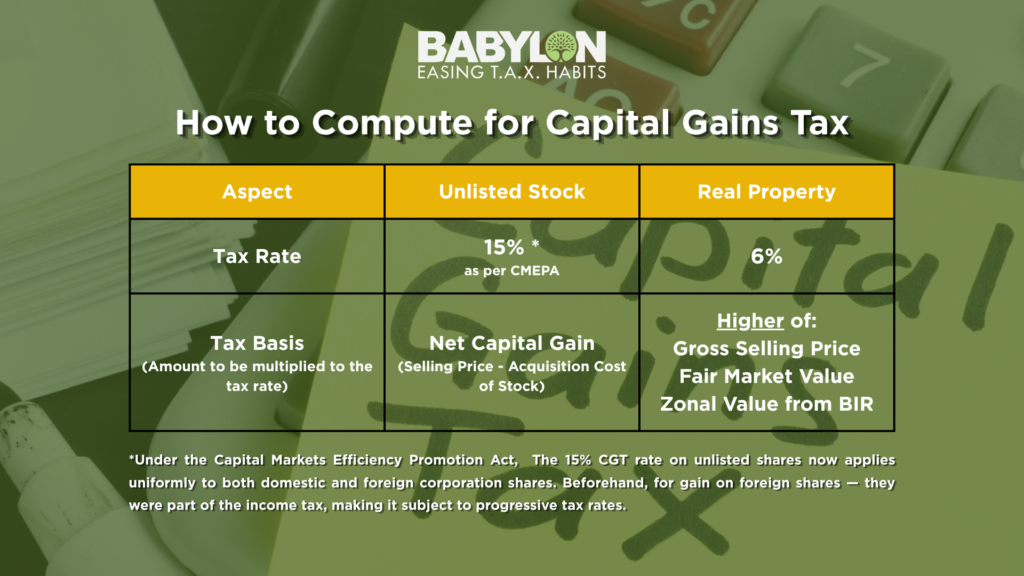
- Unlisted Shares CGT = Net Capital Gain × 15%; The net capital gain is the selling price minus the documented acquisition cost. Every peso of properly documented cost reduces your taxable gain.
- Real Property CGT = Selling Price or Zonal/Fair Market Value, whichever is higher) × 6%
- PSE-Listed Shares (STT, not CGT) STT = Gross Selling Price × 0.10%
After the CMEPA (July 1, 2025) took effect, the STT rate was reduced from 0.60% to 0.10%. Hence, for active traders, this is a major cost reduction per transaction
Filing and Payment
Unlisted Shares
- BIR Form 1707: It has the form name of Capital Gains Tax Return (For Onerous Transfer of Shares of Stocks Not Traded Through the Local Stock Exchange)
- Deadline: Within 30 days from the date of sale
Real Property
- BIR Form 1706: It has the form name of Final Capital Gains Tax Return (For Onerous Transfer of Real Property Classified as Capital Assets -Taxable and Exempt)
- Deadline: Within 30 days after the sale
Both can be filed through the eBIR Forms platform and paid via Authorized Agent Banks & Revenue Collection Officers.
Missing the deadline triggers a 25% surcharge on the tax due, 12% annual interest, and compromise penalties. CGT is not just an obligation you file whenever it’s convenient.
Key Considerations for Investors
1. Holding Period Doesn’t Affect Your Rate
Unlike other countries, the Philippines does not differentiate CGT rates based on how long you held an asset. The 15% rate for unlisted shares and 6% rate for real property apply regardless of holding period.
What your holding period affects is documentation – the longer you’ve held an asset, the more important it is to have clean, complete records of your acquisition cost.
2. Installment Sales of Real Property
If you receive payment in installments and the initial payment in the year of sale does not exceed 25% of the selling price, you may be allowed to pay CGT in installments as payments are received. This can help with cash flow planning, but consult a tax advisor before structuring a sale this way.
3. Principal Residence Exemption
The sale of your principal residence may be exempt from CGT if the full proceeds are used to acquire or construct a new home within 18 months of the sale. This exemption can only be availed once every 10 years, requires prior coordination with the BIR, and does not apply automatically.
4. Document Your Cost Basis from Day One
Proper documentation is one of the most overlooked aspects of CGT planning.
- Unlisted shares: stock certificates, shareholder agreements, and subscription receipts can serve as a reduction to taxable gain.
- For real property: retain the original Deed of Sale, Transfer Certificate of Title, and records of any capital improvements. These documents directly reduce your taxable gain and support any exemption claims.
5. Tax Treaties May Reduce CGT for Non-Residents
The Philippines has tax treaties with several countries. Non-resident investors from treaty countries may qualify for reduced CGT rates or exemptions on specific asset sales. This requires advance treaty relief applications to the BIR and does not automatically apply at the time of the transaction.
Overall
Capital Gains Tax is not just something to figure out after the sale. The best time to understand and plan your CGT exposure is before entering any transaction, ideally giving you room to structure deals first, prepare your documentation, and properly budget for the tax obligation.
Moreover, for investors navigating opportunities under CMEPA, there are clear benefits, including lower stock transaction costs, equalized tax rates on the sale of foreign unlisted shares, and, overall, a simpler framework. Yet, the responsibility for computing your dues correctly and filing them within the deadline still rests with you.
Know your CGT, compute it right, and file it on time.
Whenever you need guidance for your compliance with Capital Gains Tax, do not hesitate to reach out to us today or book a consultation now. Our team is ready to help you out with your investments.
Disclaimer: This article is for general informational and educational purposes only and does not constitute legal or tax advice.