
Compliance is Different from Being Strategic
Every month or quarter, you mostly have a meeting with your bookkeeper or accountant, sign or agree to some reports, file your taxes and other compliance dues, and just quickly move on.
But has there been an instance where you ask yourself: Do these reports actually help me in some way to make better business decisions?
Suppose your answer is “no” or “not really”; we are here to say that you are not alone. However, you are simply missing out on one of the most powerful tools for business owners — Management Accounting.
As it is common for business owners to interact with accounting due to compliance, such as filing tax returns and submitting financial statements as a requirement, it is done as Financial Accounting. But Management Accounting is just built differently: it is future-oriented, internally used for owners and managers in making smarter decisions.
What Exactly is Management Accounting?
Management Accounting, also known as managerial accounting, is the practice of making financial information useful for managers to pursue an organization’s objective. In contrast to financial accounting, which results in standardized reports for external users, such as investors, regulatory bodies, and banks — management accounting produces customized reports for internal decision-making.
In terms of historical background, management accounting is promulgated by the Institute of Management Accountants (IMA), originally founded in 1919 and has a prior name of National Association of Cost Accountants. Today, the IMA is described as the global body responsible for overseeing the professional framework and overall practice of management accounting.
Core Functions of Management Accounting
This is where things get technical, as it covers broad and complicated financial information, either quantitative or qualitative.
- Budgeting and Forecasting: It involves projecting revenues and cash flow to plan things ahead
- Cost Accounting: Analyzing the underlying costs of producing goods or delivering services
- Variance Analysis: Comparison between actual results against budgeted or forecasted considerations to determine problems early
- Performance Measurement: Tracking Key Performance Indicators (KPIs) by department or branch to know how well they execute
- Decision Analysis: Evaluating whether to make or buy supplies or materials, expand or contract business, and make pricing higher or lower in products
- Break-Even and Profitability: Knowing an estimate of how many units or clients you need to stay profitable
Notably, professionals who specialize in this field can pursue the credential of being a Certified Management Accountant (CMA). The path covers the overall strategic management, reporting and control, technology, leadership, and professional ethics to be observed as one exercises the profession.
Comparison between Financial and Management Accounting
In the Philippines, distinguishing Financial and Managerial accounting is formally done in the accountancy education itself.
For purposes of simplified distinction and understanding, the table below outlines the difference between the two:
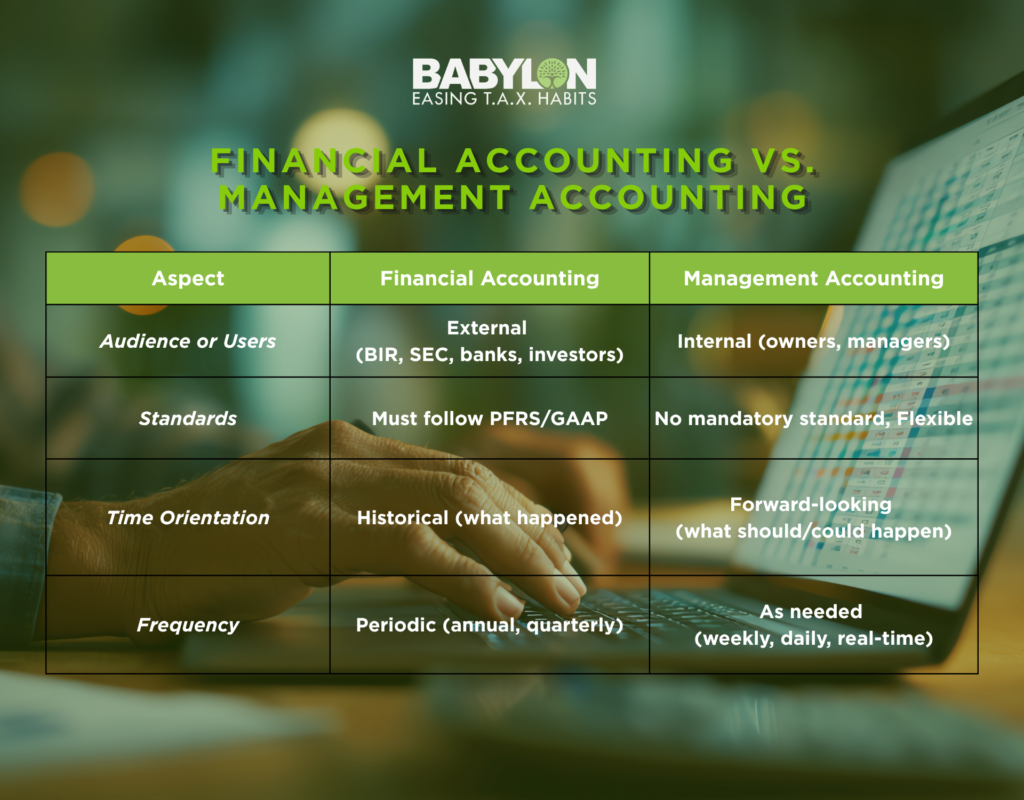
What is much more important between Financial and Management Accounting?
Both have their own different roles to fulfill, and they are equally important in the field of business. Financial accounting mostly deals with what compliance requirements require a business to do so, while management accounting provides the information that managers should digest to make the most out of the business’s resources and profitability.
Why Filipino MSMEs Should Not Skip This
The truth of the matter is that most MSMEs in the Philippines operate in a profitable position on paper but often struggle with cash flow, pricing, or scaling up. Indeed, these are the results of relying only on financial accounting but having no systems to guide decisions before expenses are incurred or how products/services are priced.
You have to consider these common scenarios where management accounting makes the difference:
- Proper Pricing of Products or Services: Without the proper basis, such as the use of cost accounting, many business owners underprice their offerings. They might cover the raw materials but often forget the overhead, labor costs, and opportunity costs incurred.
- Deciding whether to Expand or Not: A well-built budget and forecasting can help you navigate whether you should open a second branch, hire another set of team members, or invest in new equipment.
- Spotting Problems Early: With the use of tools such as Variance Analysis, you can have insight into red flags such as when actual costs are too far away from the budgeted ones.
- Improvement in Investor and Creditor Negotiations: Regardless of whether management accounting reports are for internal use only, with the appropriate financial discipline and insights, your company makes it more credible.
Build a System that Works for You
In conclusion, management accounting is another crucial matter you need to take a look at, especially when you are considering your budget, cash flow, and costing in several areas of your business.
Furthermore, you do not need a highly expert team or department to start applying management accounting. You could simply do it by doing these things:
- Separating your Compliance Books from your Decision-Making Reports
- Track your True Cost, such as considering overheads and other costs associated with running your business
- Set a Monthly or Quarterly Budget and review it
- Use financial data to plan ahead, not just report
- Consult with a Professional, such as an accounting firm, that can help you navigate things around
As you may need professional help, Babylon2k can step in for you. We work with various MSMEs across the Philippines to go beyond the usual tax compliance. Our team can help you set up practical management accounting systems so that your financial information actually helps you to grow.
Ready to turn your financial reports into real business decisions? Get in touch with Babylon2k today.