Every taxable year, numerous businesses in the Philippines tend to overpay their income tax through the means of withholding. The common unfortunate thing is that you may never see those overpayments because you do not know how to claim them back.
Worry less, for the Bureau of Internal Revenue has laid out Revenue Memorandum Order No. 25-2024 to provide a standardized way to get it back.
Salient Features of RMO 25-2024 You Should Know
The RMO 25-2024 was issued to implement the amendments in accordance with the provisions of the Republic Act No. 11976 or the Ease of Paying Taxes Act (EOPTA), prescribing how Revenue District Offices and Large Taxpayer Offices should evaluate, verify, and act on claims in relation to Excess Creditable Withholding Tax.
The Irrevocable Rule & Its Exception
As a rule, under Section 76 of the National Internal Revenue Code (NIRC), a corporation having excess income tax payments during year-end has three options it may elect:
- Pay any remaining balance
- Carry over the excess payments to the next taxable period
- Apply for a tax credit or refund
Once a corporation has elected to carry over the excess payments, that choice becomes irrevocable for that taxable period. Thus, no refund or Tax Credit Certificate (TCC) application is allowed thereafter.
However, the EOPT has added an important exception: taxpayers who originally chose to carry over their excess payments may now claim a refund, provided they have permanently ceased business operations.
Who Can Receive and Process the Claim?
The application for a TCC or cash refund is filed using BIR Form No. 1914. It can be received by two types of offices:
- The Revenue District Office (RDO) with jurisdiction over the taxpayer; or
- The Large Taxpayers Audit Division (LTAD) or Large Taxpayers District Office (LTDO) under the Large Taxpayers Service (LTS), for large taxpayers.
Only applications with the complete set of requirements will be accepted for processing. Thus, it is important for you to check the checklist of mandatory requirements as per Annex A1 (for going-concern taxpayers) or Annex A2 (for taxpayers with ongoing dissolution) under the RMO 25-2024, as incomplete applications won’t move forward.
Establish Your Excess CWT Claim
For a claim to be considered valid, the assigned Revenue Officer must verify these 3 requirements:
- Timeliness: the application must be filed within 2 years from the date that the Annual Income Tax Return was filed. Moreover, a return showing an overpayment is treated as a written claim for credit or refund.
- Income Reported: The income in which the tax was withheld must have been included in the report as part of the taxpayer’s gross income in the AITR.
- Withholding Documentation: The withholding must be supported by an authentic BIR Form No. 2307 or 1606 as applicable, making a clear identification of the taxpayer as the payee.
Hence, the burden of proof for excess CWT is carried by the taxpayer-claimant. Furthermore, the BIR will also examine whether the withholding agent actually declared and remitted the withheld amounts—making it a fundamental requirement for a CWT certificate to be genuine and accordingly matched to the payors’ filings.
The 180-Day Timeframe
With regard to the processing timeframe, the RMO states that a 180–day period is strictly observed throughout. Such period is made up of two phases:
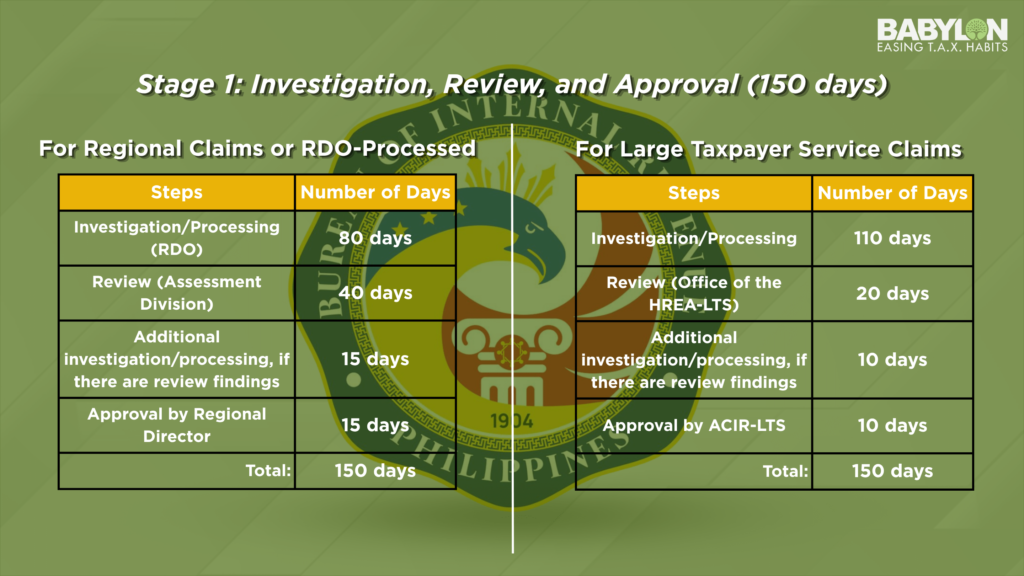
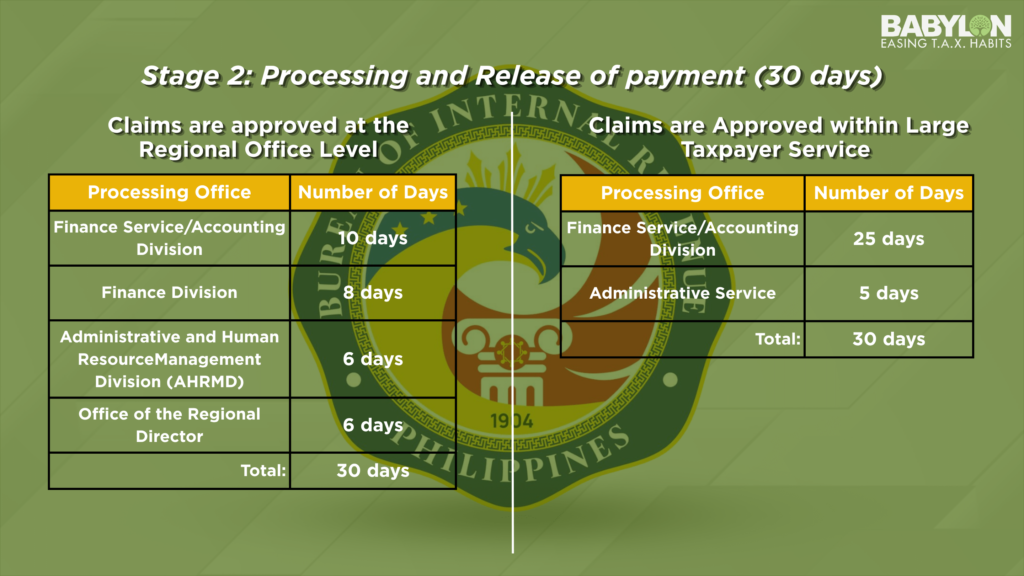
Once a claim has been approved, it will move through a series of offices of the BIR and it is also subject to the availability of funds from the Department of Budget and Management (DBM).
More importantly, outstanding tax liabilities would not stop your excess CWT claim from being processed, but any approved refund may be first applied to such liabilities. Likewise, being remarked as a “Stop-Filer” would not delay your refund claim, though that separate issue will still have to be resolved on its own case.
A Special Rule for Closing Businesses
An exception to the general rule of the 180-day timeframe is for those businesses that are winding down. According to the RMO, the BIR must decide on and release the excess CWT refund within 2 years from the date of dissolution or cessation of the business. Such period commences from the submission of BIR Form No. 1905, accompanied by complete supporting documents.
However, the refund is contingent as it will be released only after a mandatory audit of the final year tax liabilities of the business and after fully settling any outstanding obligations.
If Excess CWT Claim is Ignored or Denied
Of course, in such cases where taxpayers were left hanging in their applications, they have a remedy:
- If the BIR denies your claim in full or in part, you have 30 days from the receipt of the denial notice to elevate the concern to the Court of Tax Appeals (CTA).
- If the BIR fails to act within the 180-day timeframe, you may either appeal to the CTA within 30 days after that period lapses or wait for the BIR’s decision.
Note that whenever you pursue the judicial remedy after the 180-day period lapses, the administrative claim is considered moot and academic, and will no longer be processed at the same time.
Why Getting This Right Matters
Unclaimed Excess CWT is not just a minor accounting footnote, as it is real cash that could have been reinvested or used in your business operations. Indeed, for Micro, Small, and Medium Enterprises, it can make a difference in working capital or other expenses essential for the business.
With the prescribed guidelines and details of the RMO 25-2024, it opens an opportunity for taxpayers to have their irrevocable decisions move to a recognized and lawful exception, especially for businesses that have chosen to wind down their affairs.
Let Babylon2k Help You Recover Your Excess CWT
We understand that navigating these technicalities can be overwhelming, especially when you have to start from scratch regarding the checklist and responding to audit notices — and that’s where Babylon2k specializes.
If you believe your business has unclaimed Excess Creditable Withholding Tax sitting on the table, don’t let the two-year prescriptive period run out. Reach out to us today for a consultation, and let’s find out how much of your Excess CWT you’re entitled to recover.