As the Republic Act 12066, or the CREATE MORE law, has become effective, some businessmen—especially those who have VAT Zero-rated sales, such as Philippine exporters, freelancers, or micro, small, and medium enterprises (MSMEs)- have seemingly misinterpreted that the Act has repealed or removed the Input VAT Refund.
Some business owners are already writing off their unutilized input VAT, treating it as a permanent cost and assuming there is nothing left to claim. Yet it can be one of the most costly things an owner can do, because a nuance must be clarified.
The Reason Why Owners Give Up on Their Refund
The CREATE MORE Act has a line that may be alarming at first; specifically, section 31 of the law explicitly says that “no tax refund or credit shall be granted to registered business enterprises (RBEs). Read out of context, it may seem like a ban on VAT refunds starting the 2nd quarter of 2025.
However, that sentence is somewhat misunderstood, as the law aims to strengthen the refund system by funding a VAT Refund Center, tightening Bureau of Internal Revenue (BIR) processing deadlines, and expanding electronic refunding. Simply put, the law intends to fix the problems with VAT refunds, not to eliminate them entirely.
What Section 112 and the BIR Actually Say
Section 112(A) of the National Internal Revenue Code (NIRC) was never repealed. Thus, a VAT-registered taxpayer with zero-rated or effectively zero-rated sales may still claim back unutilized input VAT, provided it was validly imposed, paid, attributed to such sales, and properly documented. For starters, these zero-rated sales usually come from export-primary businesses, Business Process Outsourcing (BPO) and Knowledge Process Outsourcing (KPO) companies, or freelancers providing services to foreign clients—making it essential to reduce VAT liability to the BIR.
Similarly, the BIR has also acted as if the refund remedy is ongoing. Revenue Memorandum Circular (RMC) No. 37-2025 prescribes the exact procedures for processing input VAT refund claims for taxable periods starting on April 1, 2025. The issuance includes direct export sales of services, regardless of what percentage of such total sales those exports make up. Notably, the RMC was issued shortly after the CREATE MORE Act became effective.
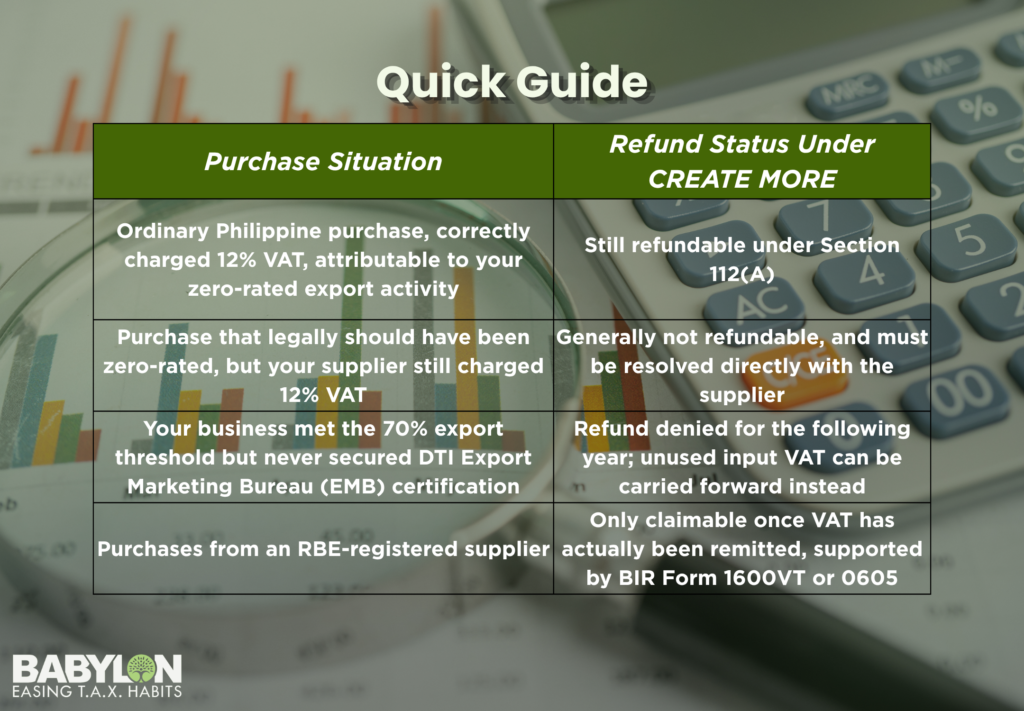
To sum it all up, the CREATE MORE prohibition on Input VAT refund is not a ban in itself, but rather a specification of which Input VAT can legally sit inside your refund claims.
So What Actually Changed for the 2nd Quarter of 2025 and Onward?
The reform is about the source of your Input VAT, not whether such refunds exist at all.
Why This Still Matters for Your Bottom Line
For export-oriented business owners, especially those with 100% zero-rated sales, input VAT has nowhere to go, as there is no output VAT to offset it against. If left unclaimed, it will sit on your books as a silent cost on a quarterly basis.
Thus, a properly filed Input VAT refund claim can bring cash back into working capital. However, the deadlines are strict, as there is a 2-year prescriptive period that runs from the closing of the taxable quarter when the zero-rated sales were made, not from the time you paid the input VAT.
For your quick reference, you may check the timetable below:
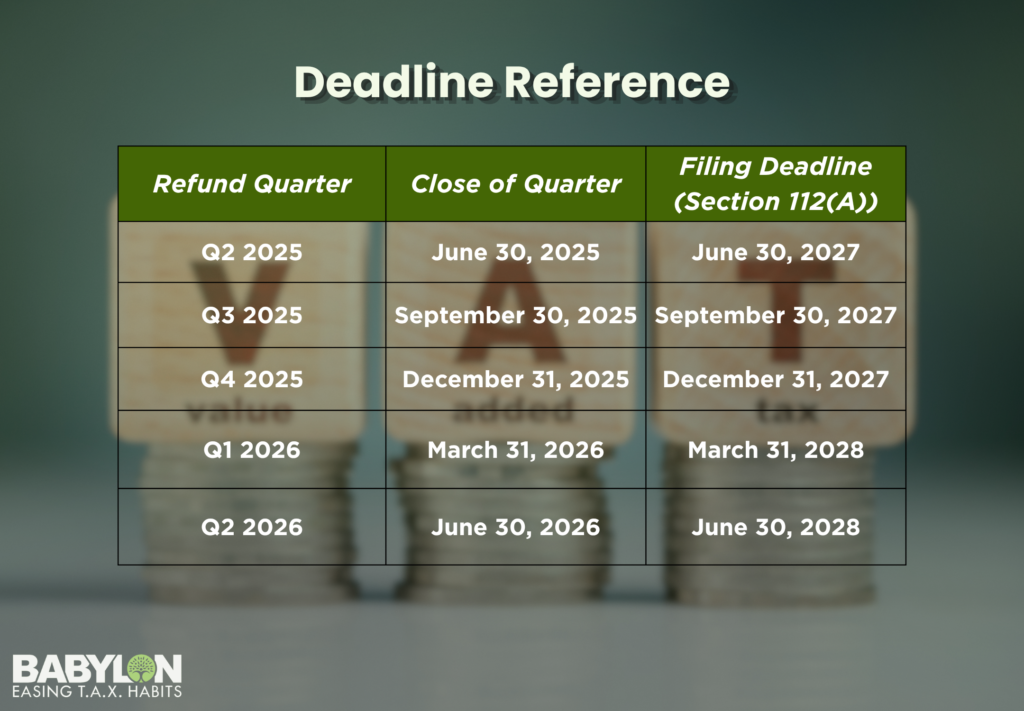
Additionally, RMC 37-2025 tightened the requirements for documentation. The quarterly VAT return must already reflect the deduction of the amount you are claiming before you file. Moreover, only complete applications under the correct checklist annex get accepted (Annex A.1.2) for claims covering April 1, 2025 onwards. Note that missing any detail and a claim will most probably be denied due to technicalities.
Don't Let a Misread Provision Cost You a Legitimate Refund
Before making any assumptions about your business, we strongly suggest you get a proper assessment of where your input VAT falls in the table above.
Here at Babylon2k, we help MSMEs and exporters to sort out which portion of their input VAT is refundable and which needs to be settled.
Talk to us before your filing deadline gets closer than it looks—Reach out to us for a review of your VAT zero-rating status, and we will help you with a filing strategy that protects your claim.