On October 12, 2026, the Bureau of Internal Revenue (BIR) issued Revenue Memorandum Circular (RMC) No. 110-2026, setting out the accreditation guidelines for Electronic Invoice Service Providers (ESPs). For an overview, an ESP cannot commercially conduct business through its e-invoicing services without the proper BIR accreditation.
Thus, if your business is covered by the BIR’s e-invoicing mandate, you probably think of just hiring a 3rd party provider to deal with the technicalities, which is a reasonable plan. But have you considered the risk of picking a provider that is not BIR-accredited?
That’s why in this article, we will explain what you should do before the December 31, 2026 deadline hits.
Basis of the Issuance
E-invoicing in the Philippines is rooted in several legal bases, such as:
- Sections 237 and 237-A of the Tax Code (as amended by the TRAIN Law and the CREATE MORE Act) are the legal basis for e-invoicing and electronic sales reporting.
- RR No. 11-2025, as amended by RR No. 26-2025, sets the coverage and moved the compliance deadline to December 31, 2026.
- RMC No. 98-2026, issued on September 22, 2026, mandates taxpayers to comply with a Permit to Issue (PTI) Electronic Invoice before any issuance of e-invoices, and to secure an Electronic Invoicing System (EIS) Certification within six months of the PTI.
- RMC No. 110-2026 covers the providers who sell e-invoicing systems and services to taxpayers.
Why Should a Business Owner Care?
It is because of a simple reason: an e-invoicing service provider status with the BIR can become a significant risk in terms of compliance.
Under RMC 98-2026, a covered taxpayer can meet its mandate via an in-house system, purchased software, or an ESP. In reality, several businesses that do not have an accounting system commonly adopt the 3rd option.
Consequently, before the issuance of RMC 110-2026, the BIR had publicly stated in an advisory on September 14, 2026, that it had not endorsed any ESP and warned companies that claimed to be BIR-accredited.
In an important note, systems that are built in-house, or software that is duly licensed to a taxpayer and runs on the taxpayer’s own infrastructure for its exclusive use, are not covered by RMC 110-2026. On the other hand, a system offered to affiliates, related parties, franchisees, or customers is treated as an ESP service unless the BIR grants an exemption.
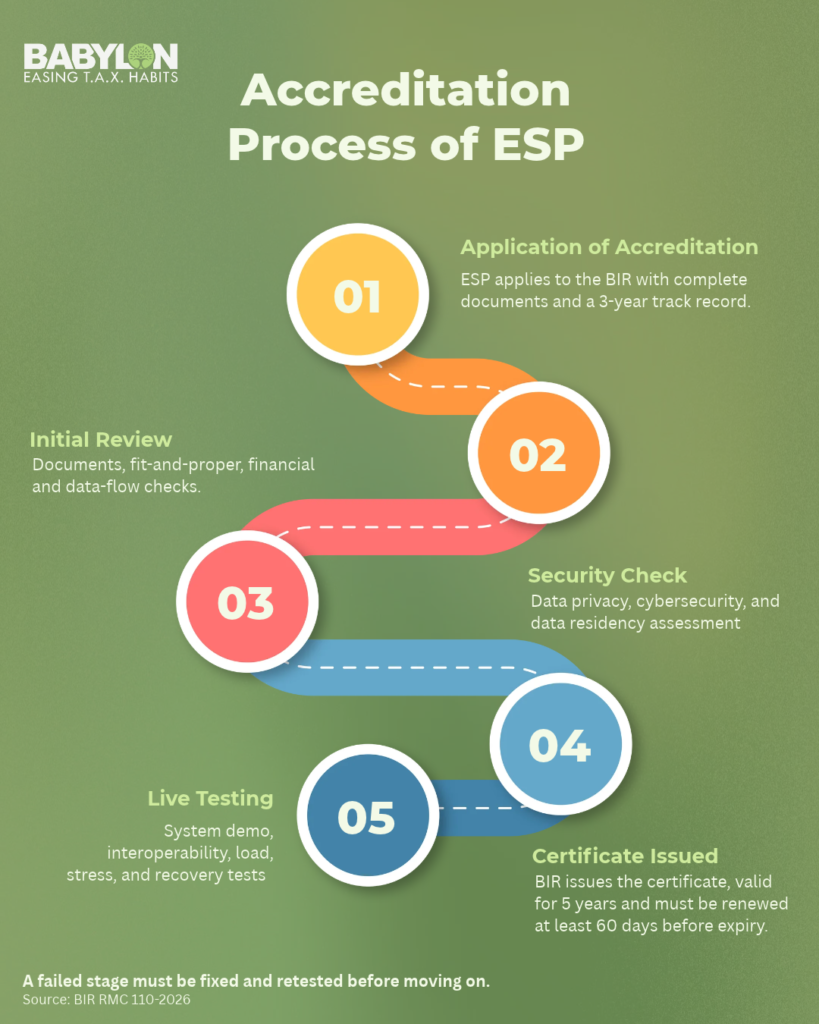
Overview of the Accreditation Process
What BIR E-Invoicing Service Provider Accreditation Requires
1. Mandatory Accreditation Before Offering Service
Under RMC 110-2026, ESPs may not commercially commence or activate their e-invoicing and electronic sales reporting service unless it has been duly accredited or holds a valid Electronic Invoicing Solutions Accreditation Certificate.
However, providers may still run demonstration and controlled pre-production testing, given that they clearly disclose that such service is not yet authorized for commercial or official use and does not process actual taxpayer transactions. Moreover, the accreditation is solution-specific, as it covers the particular solution, version, modules, interfaces, and deployment setup that the BIR evaluated.
2. A Multi-Staged Process
Paper compliance is not sufficient for the accreditation, as the circular explicitly states that documentation alone is not enough. Thus, for an ESP to be duly accredited, the mandatory stages include:
- Documentary completeness review
- Fit-and-proper and financial capacity review
- Technical architecture and end-to-end data-flow review
- Data privacy, cybersecurity, and data residency assessment (including compliance with Executive Order No. 119, series of 2026, on Government Data Classification and Data Residency, and security certifications such as ISO/IEC 27001, 27017, 27018 and SOC 1 and 2 or equivalents)
- System demonstration
- Interoperability and end-to-end transmission testing
- Load, stress, scalability, concurrency, failover, backup, and recovery testing
3. A Real Track Record
Besides the vigorous process, providers must also show independent and verifiable experience, with their corresponding financial capacity and qualified personnel.
In addition, the circular requires proof that, in each of the three preceding years, the ESP has operated systems that are collectively capable of processing at least 5,000,000 transactions annually and have supported at least 1,000 active user or customer accounts per year.
4. Validity and Renewal
The accreditation acquired will be valid for five (5) years, subject to annual compliance review and continuous monitoring. Furthermore, providers must renew their accreditation at least 60 calendar days before the expiration, and revalidate after a significant change or incident.
The Parts That Protect You as a Taxpayer
Perhaps the most useful part of the circular for the side of business owners is the provisions that will work as their safeguards in relation to an ESP.
- Transparent fees: Fees of the ESP must be reasonable and fully disclosed before onboarding.
- No vendor lock-in: An ESP cannot control or withhold your data just because of contract disputes or change of provider.
- Data portability: Such an ESP must be able to export and transfer your data to you, to the BIR, or another accredited ESP
- Your registration stays yours: You remain the holder of your PTI Electronic Invoice.
- Limited data use: Data may be used only for e-invoicing, reporting, storage, support, security, and compliance.
- Downtime support: The ESP must provide manual invoicing functionality during service interruptions, with recording, reconciliation, and linkage to the e-invoices after restoration.
- Incident reporting: Critical security or transmission incidents must be reported to the BIR in writing within 24 hours, and affected clients must be notified of material service interruptions.
- Timely transmission: E-invoice and sales data must be transmitted in real time, within three (3) calendar days from the date of the transaction. However, if immediate transmission is not possible, the system must securely queue the data and retransmit it within three (3) calendar days after restoration, without loss, alteration, corruption, or duplication.
- Records of attempted compliance: Where delayed transmission is caused by verified ESP downtime or a BIR system outage, the ESP must preserve evidence and generate verifiable reports.
The circular also says that contractual limitations of liability or data-access restrictions that conflict with its rules will not be recognized for accreditation purposes.
Important: Hiring an ESP Does Not Transfer Your Responsibility
The circular states that engaging with an ESP does not relieve a business from compliance with the statutory requirements such as issuing accurate invoices, maintaining books and records, filing the appropriate returns, and paying correct taxes.
Yet, speaking of relief, a taxpayer will not be administratively sanctioned for a transmission failure caused solely by the ESP, but only if such taxpayer exercised diligence, reported the incident on time, and followed the prescribed contingency procedures.
What About Small Businesses?
Under current and applicable rules, Micro-taxpayers are not included in the groups that are required to comply by the December 31, 2026 deadline, although they may implement e-invoicing voluntarily. Even if you are a small business, large, covered customers may ask how your invoicing process works. So, it’s better to prepare early than to rush and fix it later.
Some commentators have also pointed out that the circular’s track-record and financial-capacity requirements may favor larger providers, which could limit affordable options for small sellers. Generally speaking, that is a policy debate to look out for. Whatever the outcome, ask providers for clear pricing and compare more than one.
Final Thoughts
RMC 110-2026 raises the standard for e-invoicing providers, and it gives businesses stronger protections around fees, data ownership, and switching vendors. But the deadline is close, and you’re still responsible for correct invoicing, records, and tax payments.
Start by confirming whether you are covered, applying for your PTI, and vetting any provider against the checklist above.
Babylon2k helps MSMEs, freelancers, and entrepreneurs stay on the right side of BIR requirements. If you are unsure whether you are covered, how your invoicing and bookkeeping should change, or what to look for in a provider’s contract, reach out to our team for guidance.
This article is for general information only and is not legal or tax advice. Rules and implementation details may change, so confirm with the BIR or a qualified professional before making decisions.