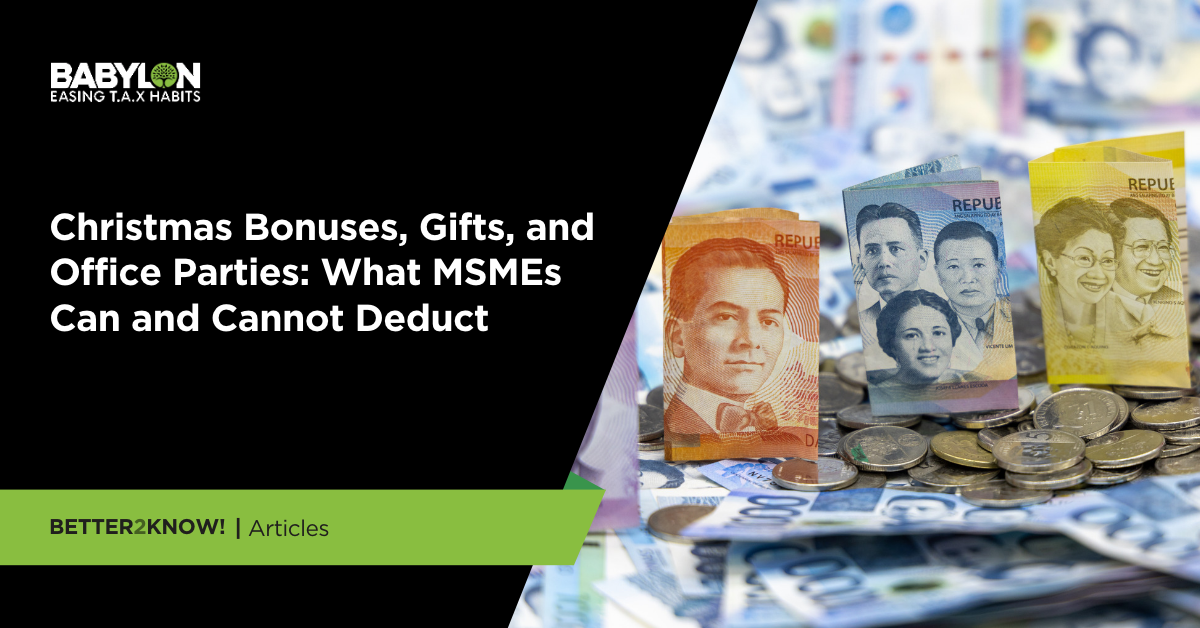
As the holiday season is around, it cannot be denied that Filipinos tend to be generous and worried at the same time—as in these times when bonuses are going out, gifts are being wrapped, and Christmas parties are booked in event venues. Thus, when the books are for closing, one big question will definitely land on the company’s accountant desk: “Can we claim all of this as an expense?”
For most Micro, Small, and Medium Enterprises (MSMEs), the answer is yes, but only if each peso is properly documented and kept within the limits that are set by the Bureau of Internal Revenue. Getting it wrong can feel like a supposed thank you from the team will turn into disallowed business deductions and penalties that are not budgeted for.
Hence, this guide walks through business owners what can deductible, what is tax-free for your employees, and where the traps are, using the rules effective this 2026 holiday season.
The Big Picture: Two Questions Commonly Asked
Every holiday expense concerns two tax questions:
- Is it taxable to the employee? – It decides whether you need to withhold tax and how the benefit shows up in payroll.
- Is it deductible to the business? – It determines whether the expense reduces your taxable income.
To answer these, BIR Revenue Regulation No. 8-2000 should come into play. It is ruled that any amount that an employer gives as a benefit, may it be classified as de minimis or a fringe benefit, it is a deductible expense for the employer. As a result, a benefit can be simultaneously taxable to your employee and deductible to you, as long as it is properly substantiated with documentations and any withholding tax was done.
Christmas Bonuses and 13th Month Pay
13th month pay is deemed mandatory for rank-and-file employees who worked at least one month during the year, and it is due on or before December 24. Meanwhile, a Christmas bonus may be given on top of that, and it is purely voluntary.
- For employees: The 13th month pay and “other benefits,” which include Christmas bonuses, productivity incentives, and other bonuses, are exempt from income tax up to a combined total of ₱90,000 per year under Section 32(B)(7)(e) of the National Internal Revenue Code (NIRC), as amended by the TRAIN Law. Therefore, any amount above ₱90,000 is added to the taxable income of the employee and is subject to withholding tax on compensation.
- For your business: Both are deductible as compensation expense, including any portion that is taxable to the employee, provided it is recorded in payroll and the proper withholding is done.
Christmas Gifts: Where "De Minimis" Comes In
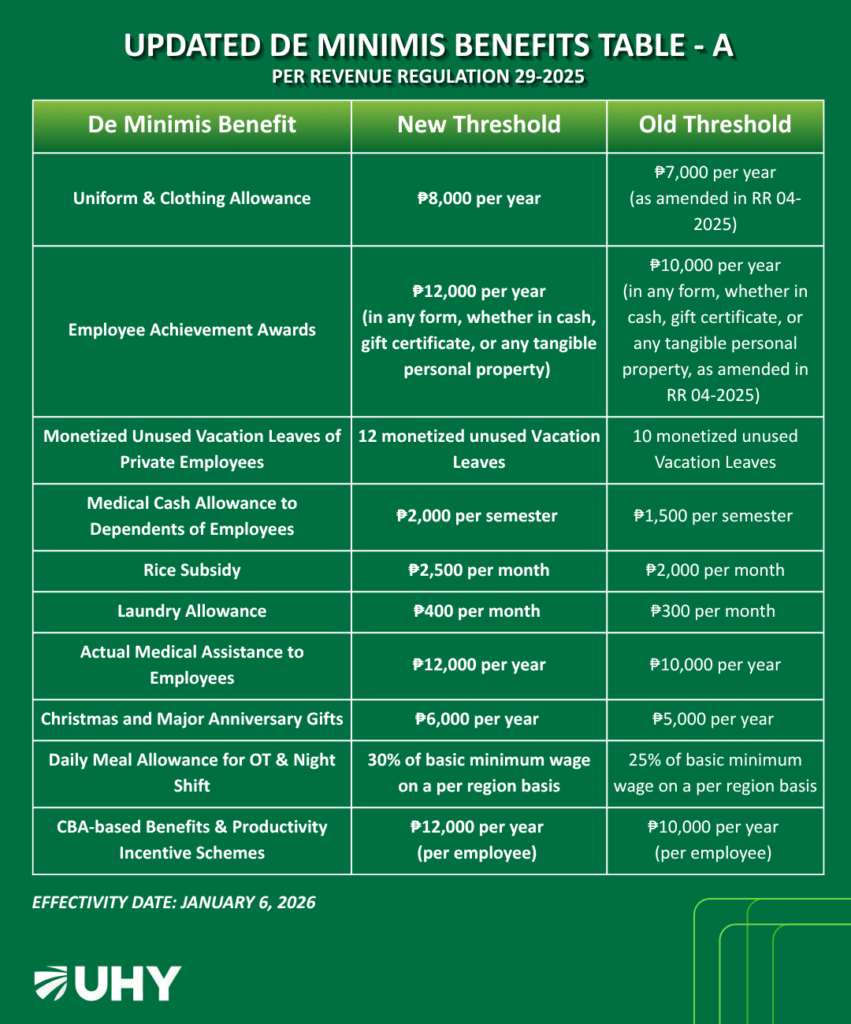
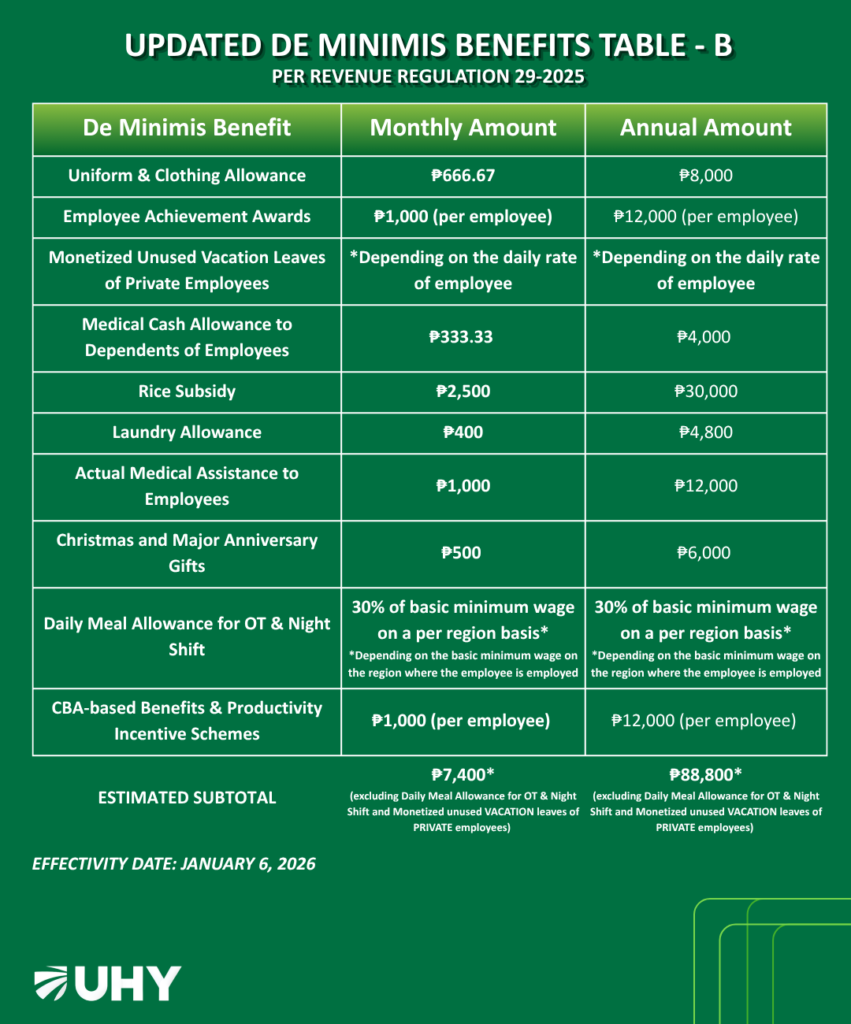
De minimis benefits are small perks that are completely tax-free for employees, as long as each benefit stays within the BIR’s thresholds. Under Revenue Regulations No. 29-2025, which took effect on January 6, 2026, the ceilings were raised. The following are the updated amounts, as provided by our trusted partner, UHY M.L. Aguirre & Co., CPAs:
What happens if a gift exceeds the ceiling?
In case the threshold has been exceeded, it becomes “other benefits” that will join the ₱90,000 ceiling along with the 13th month pay. So a ₱8,000 gift means ₱6,000 stays de minimis and ₱2,000 goes into the pool.
For businesses, gifts to employees are deductible, whether they fall within or above the de minimis ceiling.
Christmas Parties
A Christmas party conducted for your employees is generally treated as an allowable deduction, deemed an ordinary and necessary expense due to the building up of goodwill and camaraderie among the team. More importantly, BIR rulings have taken this view, provided with the condition that the expenses incurred are appropriately substantiated.
Here are a few things to keep in mind for it to be hassle-free:
- Keep it company-wide: a party open to all employees is easier to defend as a general employee welfare expense, but if it is done with limited employees like the executives, it is more likely to be questioned and treated as a fringe benefit.
- Raffle prizes and giveaways are gifts: A sound practice is to track them against each employee’s ₱6,000 Christmas gift ceiling, especially if you also give out gift packs.
- Employee parties are not client entertainment: The BIR’s cap on entertainment, amusement, and recreation (EAR) expenses targets client and guest representation, and the regulations exclude expenses treated as compensation or fringe benefits.
Client and Business Partner Gifts
Any form of gifts to clients, customers, and suppliers are considered as representation expense. Thus, these are subject to the limits under Revenue Regulations No. 10-2002:
- 0.5% of net sales for businesses selling goods
- 1% of net revenue for businesses selling services (including professionals and lessors)
- Businesses with both are apportioned
Anything above the cap is not deductible, and it cannot be carried forward. Additionally, client gifts must also be directly connected to your business, backed by receipts, and documented with the date, place, purpose, and recipient.
However, there is a caveat in relation to giving gifts:
- Gifts or “tokens” to government officials or employees that are contrary to law, public policy, or public order are never deductible.
- Do not hide client gifts under another expense category to avoid the cap, as the BIR can reclassify expenses it finds were shifted for that purpose.
Fringe Benefit Tax: When the Employer Pays More
Fringe benefit tax (FBT) is a 35% final tax on the grossed-up value of fringe benefits given to managerial and supervisory employees. It is crucial to note that rank-and-file employees are not covered.
Typical fringe benefits include housing, vehicles, and expense accounts. During holidays, the usual consideration is a benefit that is not de minimis and not just a simple compensation, such as a company-paid holiday trip exclusively for managers and higher-level positions executives.
Moreover, the FBT paid is deductible to the employer—depending on how the benefit is valued, as the benefit itself may not be separately deductible, which is why classification matters before you commit to a plan.
Common Mistakes MSMEs Make
Here are the mistakes you should definitely avoid:
- Cash gifts with no payroll record: Cash handed out informally cannot be substantiated and may be disallowed.
- Counting only 13th month pay toward the ₱90,000 and forgetting the Christmas bonus, productivity incentives, and excess de minimis.
- Using outdated ceilings: The 2026 de minimis limits under RR 29-2025 are higher than the old ones, so check your payroll settings and ensure proper withholding among employees.
- Mixing client gifts and employee gifts in one expense account, which hides the EAR cap.
- No receipts in the company’s name: An expense without a valid invoice or receipt is at risk, even if the spending was genuine.
Make Your Holiday Spending Count
Year-end generosity should not turn into a January audit problem. Thus, a short review of your payroll and expense records before the books close can help you keep every deductible peso and avoid tax surprises.
Here at Babylon, Easing TAX Habits, we help Philippine MSMEs, freelancers, and entrepreneurs keep their compliance simple and their deductions defensible—from payroll tax reviews to year-end tax planning. If you want a second pair of eyes on your holiday benefits before December 31, reach out to our team, and we will handle the rest for you.
References
- Tax Code of 1997, as amended by RA 10963 (TRAIN Law), Section 32(B)(7)(e): 13th month pay and other benefits (₱90,000 ceiling)
- BIR Revenue Regulations No. 29-2025 (effective January 6, 2026)
- BIR Revenue Regulations No. 8-2000 (Jur.ph)
- BIR Revenue Regulations No. 3-98
- BIR Revenue Regulations No. 10-2002
- BIR Revenue Memorandum Circular No. 81-2025
This article is for general information only and is not tax advice.