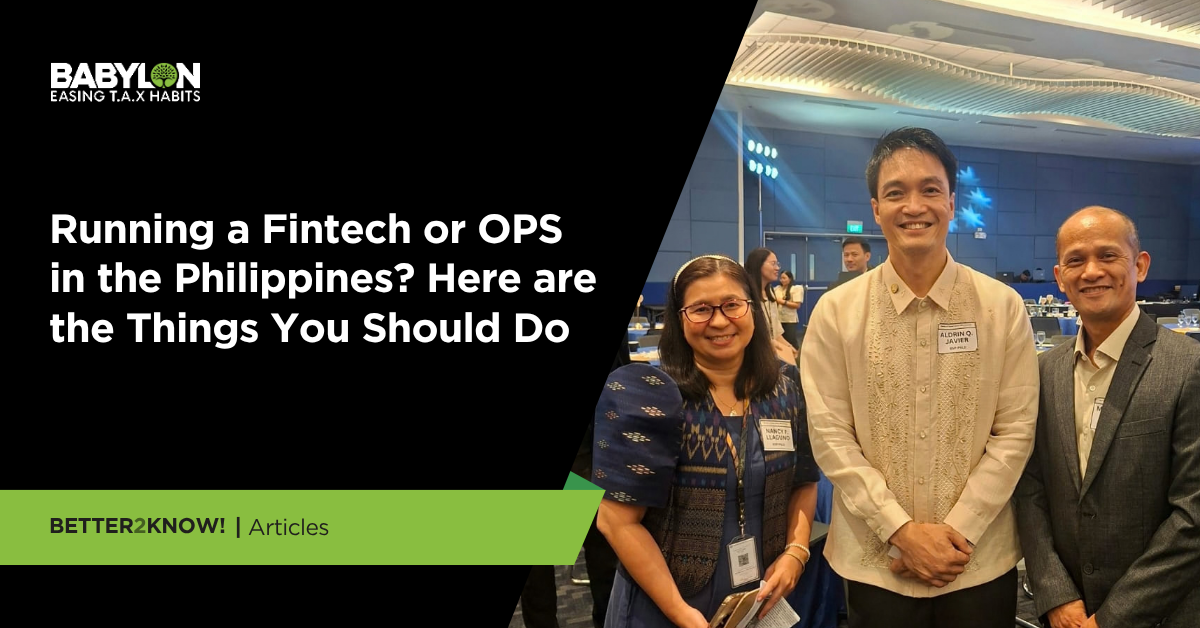
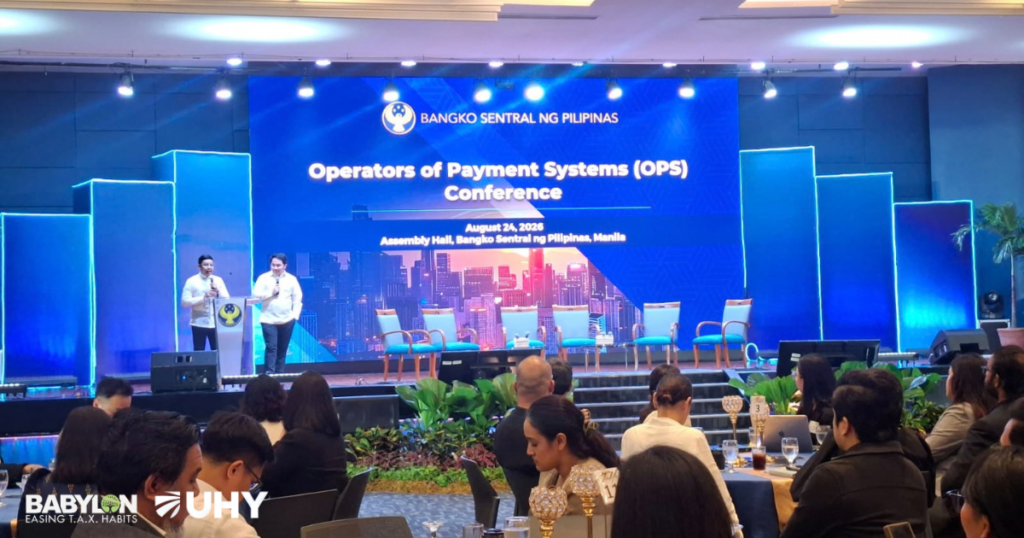
Insights from Michael L. Aguirre, CPA, MBA, MST, Founder of Babylon2k, following his attendance at the Bangko Sentral ng Pilipinas (BSP) Operators of Payment Systems (OPS) Conference on August 24, 2026, at the BSP Assembly Hall in Manila.

The Financial Technology (FinTech) landscape in the Philippines is truly growing fast. From digital wallets to online payment platforms—we cannot deny that these are part of everyday life, whether you are a consumer or a business owner, and that makes the Bangko Sentral ng Pilipinas watch these Operators of Payment Systems (OPS),
At the OPS Conference, the BSP’s Payments Supervision and Licensing Department made one message clear: payments supervision is now considered a crucial mission. OPS process high-volume, high-frequency retail payments. Indeed, disruptions can quickly escalate into system-wide incidents, and public confidence in digital payments depends on reliability and safety, not just efficiency.
For founders, this means BSP rules for fintech and OPS aren’t a one-time hurdle—they shape how you register, operate, report, and grow. Here is what the conference covered, and what we recommend to every fintech and OPS owner (and what to avoid).
Registration is just the Beginning
The BSP was clear: registration starts the supervisory relationship, and supervising OPS is an ongoing process. Moreover, the BSP runs a perpetual, risk-based surveillance program that checks OPS compliance, activities, and risk profile.
Notably, the registration and oversight path has four steps:
- Register with the BSP: Under Circular No. 1049, registration is essential, and the BSP will assign an applicant company its unique institution code.
- Complete your governance self-assessment: As prescribed under Circular No. 1127, this helps you check your own compliance and spot areas to strengthen.
- Register with the Anti-Money Laundering Council (AMLC): Using your assigned BSP institution code, comply with the AML/CTPF requirements that fit your activities and regulatory classification.
- Submit regulatory notifications: The BSP should be aware whenever your information changes or is updated.
Your Obligations Depend on Your Activities
Not every OPS carries the same weight of obligation in terms of compliance. The BSP layers requirements based on the nature and scope of what you intend to do:
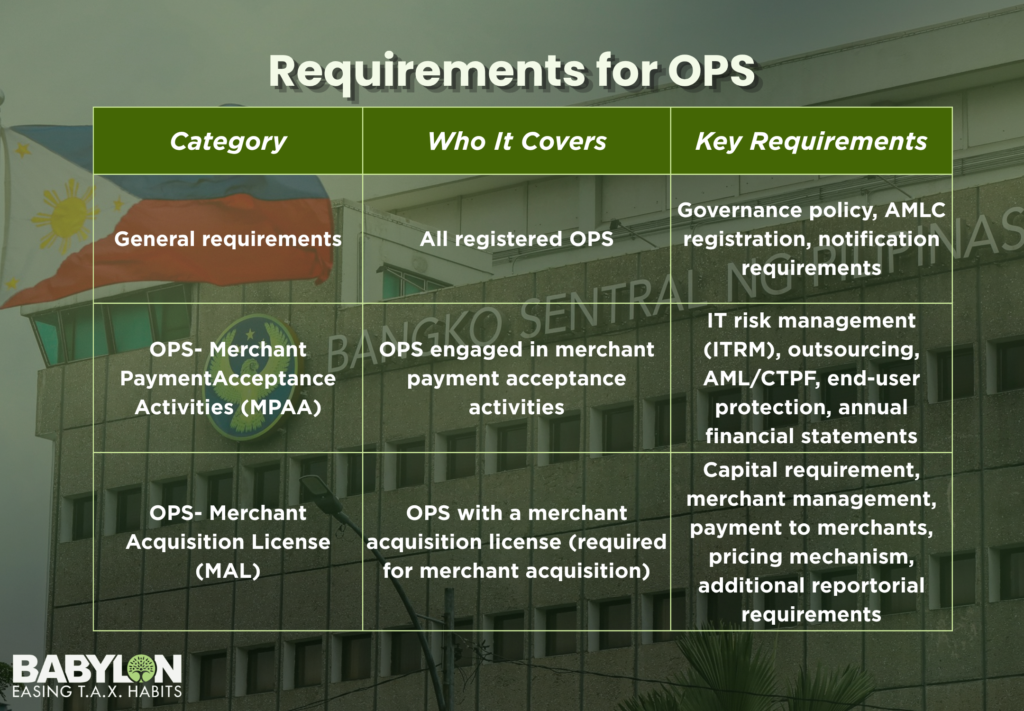
The DOs: Establishing a Strong Foundation
1. Register properly and follow the sequence
It is a must to register with the BSP as prescribed under Circular No. 1049, then complete your governance self-assessment. Afterward, register with the AMLC using your BSP institution. Additionally, if you aim to engage in merchant acquisition, such a license is required to be acquired first.
2. Keep merchant and customer funds separate
Under the merchant payment acceptance framework as outlined in Circular No. 1198, OPS with a merchant acquisition license must keep funds collected on behalf of merchants in designated accounts, which are essentially separate from their own operating funds.
3. Invest in IT risk management and cybersecurity
As hackers are prevalent on the internet and in the environment that OPS operates in, appropriate IT risk management is fundamental for OPS engaging in merchant payment acceptance. Thus, building a solid ITRM framework is necessary to protect financial data, retain resiliency in systems, and keep user trust high.
4. Pay your merchants on time.
Critically, Circular No. 1198 mandates timely and complete settlement to merchants—requiring no longer than two business days from the day the funds are received for transfer to a merchant. Note that fast and reliable payouts keep your merchant network happy and make your operations compliant.
5. Submit complete, accurate, current, and timely reports.
Annual financial statements are commonly part of the reportorial requirements. Yet, the BSP also asked OPS to submit outstanding documents such as the OPS Profile, the AMLC/CTPF Survey Questionnaire and Annex A (which are information and documents for the supervisory engagement).
The DON'Ts: Notable Mistakes You Should Avoid
1. Ignore your capital requirement.
If you are an acquirer of merchants, certain capital requirements apply to your license. Hence, it is crucial to confirm the current amounts as prescribed in the Manual of Regulations for Payment Systems (MORPS) and ascertain that your capital will not fall short.
2. Treat the governance self-assessment as paperwork.
The self-assessment under Circular No. 1127 is an opportunity to find the gaps before the BSP does. Truly, compliance is not just a checkbox—it is also your shield.
3. Leave the BSP in the dark.
Any form of major updates, such as changes in ownership, leadership, or adopted business model, must be reported through the regulatory channels. Non-notification to the BSP can lead to penalties.
4. Let pending items pile up.
Accomplish outstanding requirements and address any previously communicated compliance matters. If anything is unclear, you should raise it with your corresponding BSP account officer, rather than just guessing things out.
5. Stop tracking new issuances.
The BSP expects that OPS are ahead of the applicable regulations and subsequent issuances, as falling behind is not an excuse for non-compliance.
Key BSP Issuances Every OPS Should Know
As mentioned, OPS should maintain up-to-date knowledge of BSP issuances; here are selected key issuances that are helpful. However, this list is not exhaustive, so always refer to the latest MORPS and other applicable BSP issuances.
- Circular 1049: Rules and Regulations on the Registration of OPS
- Circular 1055: National QR Code Standard (QR Ph)
- Circular 1089: Payment System Oversight Framework
- Circular 1126: Adoption of the Principles for Financial Market Infrastructures (PFMI)
- Circular 1127: Governance Policy for OPS
- Circular 1138: Regulatory Reporting Standards for OPS
- Circular 1160: Financial Consumer Protection Framework
- Circular 1198: Regulatory Framework for Merchant Payment Acceptance Activities (MPAA)
- Circular 1238: Amendments to the NRPS Framework and the MPAA Framework
- Memorandum M-2026-039: Guidelines on the Registration of OPS
- Memorandum M-2026-026: Amendments to the NRPS Framework and the MPAA Framework
- Memorandum M-2026-017: Reiterating Guidelines on Ensuring Integrity of Payment Activities
What Is Coming Next
The BSP gave a heads-up that the OPS regulatory framework will continue to enhance. Some of the forthcoming items include:
- Payment Services Report (PSR)
- AMLA guidelines and reporting requirements
- Financial reporting for OPS
- Risk management guidelines
- Licensing of other types of OPS
- Examination of OPS
The direction is much clear: clearer accountability, better supervisory visibility through improved data and reporting, and structured coordination among the BSP, OPS, and industry bodies. The BSP’s stated goal is a simpler, safer, more transparent, resilient, and inclusive payment ecosystem.

The Bottom Line
In the Philippine FinTech landscape, compliance is indeed your competitive advantage. By following the BSP’s rules, you assure customers through protection. You also secure your license and build a lasting brand.
Fintech businesses that thrive long-term aren’t just the ones with the best technology. They are the ones regulators and customers can trust.
Babylon2k supports fintech startups, payment operators, and growing businesses with accounting, tax, audit, and business advisory services, including audited financial statements and reporting support that regulators expect. Talk to the Babylon2k team today and keep your business audit-ready and compliant.