
Have you ever imagined that your trusted bank has been ordered closed by regulatory bodies such as the Bangko Sentral ng Pilipinas? It may seem unlikely, but it’s still a risk you need to consider.
Say less, as this is where the Philippine Deposit Insurance Corporation (PDIC) steps in. Whether you are a private employee, a freelancer, or a business owner, it is important to understand the essence and the circumstances under which your deposits are insured.
What is the PDIC Law?
The PDIC law, which is formally known as the Republic Act No. 3591, was legislated way back in 1963. Furthermore, it has undergone numerous changes, and its recent amendment was Republic Act No. 11840 (2022). Such amendments were made to keep up with the needs of Filipino depositors and consider the economic factors in the Philippines.
Regarding its essence, PDIC’s purpose is to:
- Protect Depositors by providing insurance for deposits placed under PDIC member banks
- Promote Financial Stability through establishing public confidence in the Philippine banking industry
- Act as a Receiver and Liquidator of banks whose cases are closed by the Monetary Board of the BSP
Moreso, it’s important to highlight that as the PDIC may seem a corporation per se due to its way of establishment — yet, it is actually a form of government instrumentality that is responsible for co-regulating banks with the BSP.
How Much Does PDIC Actually Cover?
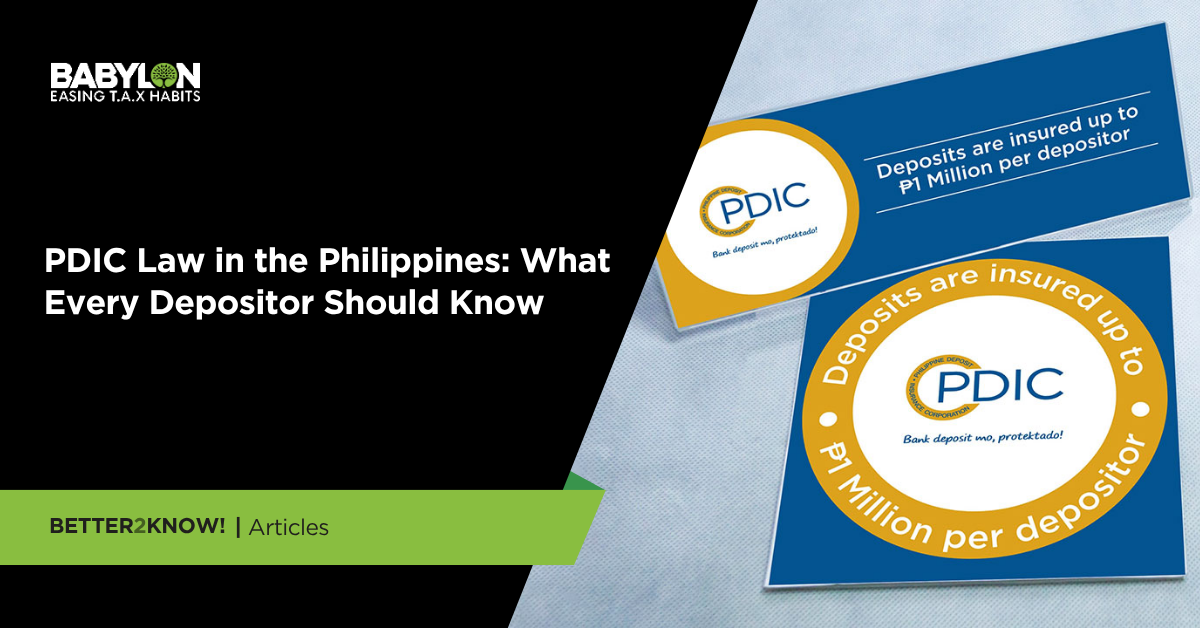
Recently, the Maximum Deposit Insurance Coverage (MDIC) has been increased from ₱500,000 to ₱1,000,000 per depositor, per bank. The PDIC Board made such an adjustment of Directors to provide enhancement regarding the protection and confidence of the public in relation to their deposits.
Additionally, it is crucial to know that as a rule, the BOD of the PDIC can only increase the amount threshold upon having reasonable justifications, such as due to inflation and other economic factors that might affect the stability of the banking system.
What Deposits Are Covered?
Before naming all of the deposits covered under the PDIC, it is crucial to note that such insured deposits are only claimable on the grounds that the bank has been ordered closed. Hence, one cannot claim whether the bank was a victim of theft, force majeure, or other instances.
Thus, in terms of the insured deposits, they must be valid and legitimate, such as deposits in:
- Savings accounts
- Special savings accounts
- Demand/checking accounts
- Negotiable Order of Withdrawal (NOW) accounts
- Time deposits
- Deposits in both Philippine pesos and foreign currencies
Apart from this, membership with the PDIC is mandatory for all banks licensed under the BSP. As a result, it makes all banks subject to insured deposits according to their depositors and up to the MDIC.
What’s Not Covered
Not everything that is labeled as “deposit” qualifies for the insurance provided by the PDIC. The law explicitly excludes:
- Investment products such as bonds, securities, unit investment trust funds (UITFs), and other similar instruments
- Trust accounts and other fiduciary arrangements, unless truly “deposit-like” in nature
- Unfunded, fictitious, or fraudulent deposit accounts
- Deposits linked to unsafe or unsound banking practices
- Deposits determined to be proceeds of unlawful activity
Indeed, knowing these exclusions matters as they explain why some depositors may find certain accounts denied insurance coverage when a bank has been ordered closed.
Why This Matters for Your Business and Peace of Mind
Whether you are an MSME owner or working as a freelancer in the Philippines, the PDIC helps you to be secured whenever a bank reaches a point of hardship. here are the reasons why you should take this more seriously:
- It’s Free: You do not pay additional fees for this protection, as the banks shoulder the assessment fees paid to the PDIC.
- Coverage is automatic: From the moment you deposit an account with a PDIC member bank, your funds are automatically insured up to the MDIC. Thus, it is advisable to split your money among several banking institutions to maximize its coverage.
- Protection against Worst-Case Scenario: if the bank you entrust with your funds is ever ordered closed, PDIC steps in as the receiver and liquidator that would work on settling your deposits.
Undoubtedly, for business owners managing several accounts, having a strong understanding of how PDIC works can help you structure your accounts strategically.
Protect Your Deposits & Your Business the Smart Way
In conclusion, understanding the PDIC law is not just about giving trivial facts in the Philippine banking industry; it is truly about making informed financial decisions that protect your hard work.
Here at Babylon2k, we help MSMEs, freelancers, and entrepreneurs make sense of complex financial and regulatory matters — from tax compliance to smart financial planning- so you can focus on growing your business with confidence.
Talk to our team today and let us help you build a stronger, more secure financial foundation for your business.