When President Ferdinand Marcos Jr. signed the 2026 General Appropriations Act (Fiscal Budget), he vetoed more than ₱92.5 billion in unprogrammed appropriations — funds that may be released only when specific conditions are met, such as excess revenues, new revenue sources, or additional borrowings beyond original projections.
What Was Included in the Veto
While the veto itself raises no inherent concerns, two items in particular warrant scrutiny:
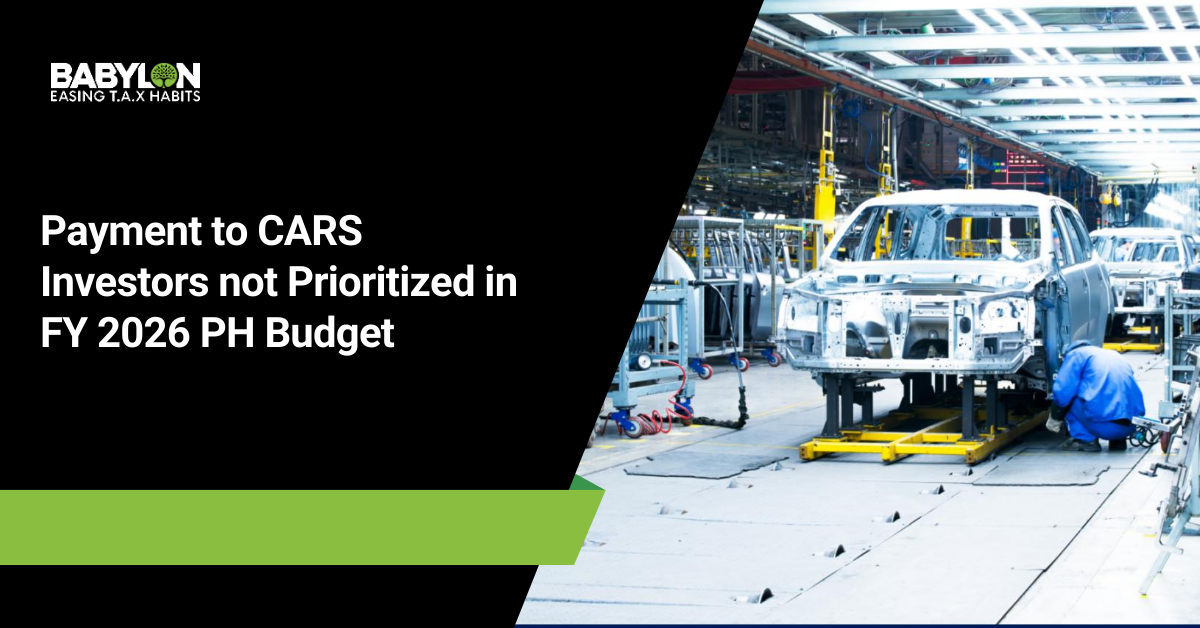
Fiscal Support Arrearages for the Comprehensive Automotive Resurgence Strategy (CARS) Program – ₱4.321 Billion
These funds were designated to pay Tax Payment Certificates already issued to registered participants of the CARS program under Executive Order No. 182, series of 2015. The recipients— Toyota Motor Philippines Corporation, Mitsubishi Motors Philippines Corporation, and automotive parts manufacturers—have met their performance targets and are entitled to these incentives.
- Revitalizing the Automotive Industry for Competitiveness Enhancement (RACE) Program – ₱250 Million
Similar to CARS, this program provides fiscal support to newly registered and qualified carmakers to enhance the competitiveness of the Philippine automotive manufacturing sector.
Both programs were proposed by the Philippine Board of Investments (BOI).
The Problem: Unpaid Government Obligations
The government promised incentives to investors in the CARS Program. To date, only ₱1.4 billion has been paid, leaving ₱3.987 billion outstanding. These are not grants or subsidies—they are earned incentives for companies that fulfilled their commitments under a government program designed to revitalize the automotive industry.
The question now is: Will investors receive what they were promised?
What happened during the Budget Process?
I. The Initial Budget Proposal
The National Expenditure Program (NEP)—the Executive Department’s detailed budget proposal prepared by the Philippines Department of Budget and Management (DBM)—serves as the foundation for the annual General Appropriations Bill.
In the FY2026 NEP, the BOI’s proposed budget totaled ₱1.041 billion, which included:
- ₱225.653 million for CARS Program arrearages
- ₱250 million for the RACE Program
Another ₱333.5 million was included as unprogrammed appropriations for CARS arrearages (contingent on additional funds). Even at this stage, the proposed allocations fell drastically short of the ₱3.987 billion owed. The standard explanation—lack of “fiscal space”—rings hollow when the NEP reflects the President’s priorities. The message it was sending was that paying CARS investors was not a priority.
II. Budget Deliberation in Congress
House of Representatives: The proposed ₱1.041 billion BOI budget was maintained and without changes to the CARS appropriations.
Senate: A different approach emerged. Senators reduced the BOI budget to ₱565.408 million by removing CARS and RACE allocations from programmed appropriations. However, they increased the CARS Program allocation in unprogrammed appropriations by ₱3.987 billion, bringing the total to ₱4.321 billion. The RACE Program was similarly moved to unprogrammed appropriations.
However, this raises a critical question: Why impose these obligations on unprogrammed appropriations rather than on programmed appropriations? Moving them to unprogrammed funds made their release conditional and uncertain—hardly appropriate for obligations the government has already incurred.
The Budget Bicameral Committee adopted the Senate version and transmitted it to the President for approval.
III. Budget Approval and Veto
President Marcos vetoed the ₱4.321 billion CARS allocation and the ₱250 million RACE allocation from unprogrammed appropriations. The final approved BOI budget of ₱565.408 million in the programmed appropriations contains no funding for either CARS/RACE.
In his veto message, the President stated this was “a measured exercise of Executive authority to rebuild public trust in the budget process, by ensuring that public funds are expended in clear service of national interests.” He emphasized that unprogrammed appropriations would not be “misused or treated as a backdoor for discretionary spending.”
IV. The Uncomfortable Questions
How could fulfilling contractual obligations to investors who met their targets be considered “misuse” of funds? How do these payments conflict with national interests? Does the President view the BOI with the same degree of suspicion he holds toward agencies such as the Department of Public Works and Highways?
More fundamentally: What message does this send to current and potential investors about the reliability of government commitments in the Philippines? The CARS and RACE programs were designed to develop a strategic industry. The government made promises, companies delivered, and now those promises remain unfulfilled. This is not just a budgetary issue—it’s a credibility crisis that could undermine investor confidence for years to come.
Article written by: Restituto Felipe Gabuya
If your business requires expert guidance in navigating Philippine government incentives and regulatory challenges, Babylon2k and its Trusted Partners provide strategic consulting tailored for investors. Our team helps mitigate risk, address regulatory barriers, and pursue rightfully earned incentives. In an environment of policy uncertainty, contact us to protect and advance your investments in the Philippines.