
As digital finance gradually takes over, an idea is beginning to revolutionize the global commercial community: The Finternet Technology – a unified, interoperable “Financial Internet” designed to address the problems of modern financial systems, all in a seamless network.
At the 2025 Singapore Fintech Festival, insights from the conference highlighted the Finternet vision as the central topic. Leaders, regulators, and innovators described a future of asset tokenization, AI-driven financial agents, and interoperability of digital money, laying the foundation of a global economic system.
The Finternet is no longer just a theory to study its feasibility; it is already becoming more realistic and versatile as technological advancements unfold.
What Is Finternet Technology?
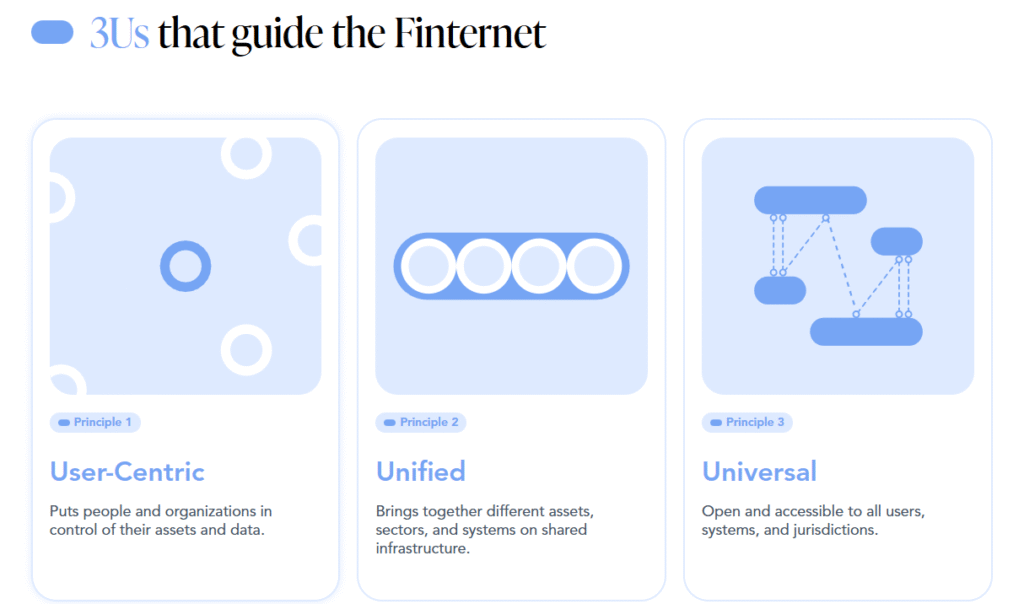
Introduced by Infosys Chairman Nandan Nilekani, the Finternet Technology represents a versatile, global digital infrastructure wherein:
- All financial assets can be tokenized.
- Payments move instantly across interconnected networks.
- AI serves as a Finance Agent, helping users manage investments, navigate investments, and make transactions.
- Cash, deposits, stablecoins, and Central Bank Digital Currencies (CBDC) exist on a unified ledger or platform.
- Accessibility is universal for institutions, Small and Medium Enterprises (SMEs), and everyday internet users.
As stated by Nilekani, the Finternet solves one of the world’s critical financial challenges: “We are building solutions per problem, but that’s so slow… We solve this with the Finternet.” Additionally, he identified four priority Finternet initiatives to focus on: cross-border payments, loyalty and rewards, securitization, and democratizing wealth access for retail investors, regardless of location.
Thus, this is not just about making payments or settling contracts and deals — it is a pivotal restructuring of financial systems that enables any assets, currencies, networks, and users to interact seamlessly.
The Foundation of Finternet: Tokenization
The SFF 2025 conference has made a crystal-clear point: Tokenization is laying the groundwork for Finternet Technology.
Singapore’s central bank, the Monetary Authority of Singapore (MAS), and other global partners emphasized how tokenized finance has moved from experimentation to early commercial use.
- Real-World Tokenized Use Cases are Already Working – Project Guardian pilots have successfully tokenized Foreign Exchange Trades, Bonds, Money Market instruments, and bank deposits. The tests showed promising results: they achieved near-instant settlement, were available 24/7, and were automated via smart contracts, deemed essential capabilities for Finternet Technology.
- Networks Must Be Interoperable, Not Isolated “Walled Gardens.” – A primary goal depicted at SFF 2025 was for tokenized assets to be effective; platforms must recognize each other’s tokens. This aligns with the Finternet principle that such value should flow freely across economic systems, as website links can be accessed and interacted with across the internet.
- Digital Money Regulations and Reliability – Finternet is established as a platform for trustworthy settlement assets, including Tokenized Bank Deposits, Well-regulated Stablecoins, and Wholesale CBDCs. The MAS’s stablecoin regulatory authority is a significant step taken towards fostering a safe, interoperable digital money.
- Institutional-grade distributed ledger technology infrastructure is essential to sustain global interoperability; networks need transparent governance, predictable fees, privacy options, and regulatory frameworks to build confidence at scale.
Indeed, Tokenization is a crucial step for Finternet to become revolutionary within the global financial community.
The Finternet Vision Becoming a Reality
One of the most influential messages from Nilekani at SFF: “On the Finternet, Filipinos can buy tokens from Singaporeans anytime.” This depiction captures how the Finternet enables a global, retail-level access to tokenized assets, such as Filipinos investing in a tokenized Singapore REIT, Singaporeans investing in Philippine tokenized green bonds, SMEs in ASEAN having the accessibility for cross-border credit via tokenized invoices, and ultimately, Overseas Filipino Workers (OFW) sending tokenized money home in an instant and for a lower cost.
In addition, to support the technology, several major initiatives were launched.
- Project BLOOM – a global consortium of 16 banks and fintechs developing shared standards for tokenized deposits, interoperable settlement models, and cross-bank tokenized money networks.
- Global Later 1 (GL1) – A public-private initiative supported by the MAS, Bank of England, European Central Bank, and others to build the interoperable international payment platforms.
- Cross-Border CBDC and Tokenized Repo Trials – pilots like “Les Gardiennes” are testing tokenized interbank transactions between central banks.
- VISA and Mastercard Integration of Stablecoins – these networks are bringing regulated stablecoins into global payment systems such as VISA Direct for stablecoin wallet payouts and Mastercard Move for stablecoin transfers via Thunes.
With these innovative initiatives, Traditional Finance and tokenized finance are effectively merged, forming a building block for Finternet Technology.
Why This Matters for Businesses
The Finternet technology has significant real-world implications and is one business that should be looked forward to in the near future.
- Faster, Cheaper Payments – payments can progress and be completed immediately, available 24/7, even across countries.
- Better Auditability and Compliance – tokenization in workflows creates a much cleaner and real-time financial document trail, reducing reconciliation constraints.
- New Means to Access the Global Capital – tokenized markets allow SMEs to do fundraising beyond local boundaries.
- Interoperability as a Competitive Advantage – aligning systems with the Finternet technology will outperform isolated legacy infrastructures.
Hence, companies, especially in Southeast Asia, should begin preparing now and be forward-thinking about this new technology that will gradually take place soon.
Your Partner in Finternet-Ready Financial Operations
As tokenization, digital money, and AI technology bloom, organizations must ensure their accounting, audit, and financial controls can adapt to new models.
Babylon2k helps businesses become Finternet-ready through the modernization of accounting workflows, data integrity, and financial controls optimization, and digital finance compliance services. Message or reach out to us today to make your business future-proof and prepare for the next generation of technological advancement.