Situation as of writing on October 14, 2026. Conditions in the Gulf and DMW rules change quickly, so confirm the latest advisories before making decisions.
The Strait of Hormuz has not been in a good position for several months, as shipping through it has been blocked since February 2026, when the US and Israel started striking Iran. Truly, it is a key matter, as 20% of the world’s oil trade commonly passes through this narrow waterway.
In the case of the Philippines, which is considered the world’s largest supplier of seafarers, it is considered an immediate business and household problem. Roughly 460,000 Filipino seafarers work in global shipping, making up 13% of the global total. Hence, when a crisis occurs like in Hormuz—Filipino crews, their families, and the manning agencies feel the burden first.
Thus, it is critical to know what the numbers show, what current rules apply, and what manning companies can do to protect their crews, cash flow, and clients.
Why Hormuz Matters to the Philippine Economy
The Philippines’ Weight in Global Crewing
For context, the BIMCO & ICS Seafarer Workforce Report 2026 estimates global seafarer supply at 2.57 million, with the Philippines contributing 203,179 officers and 256,968 ratings. Altogether, the top five supplier countries, with the Philippines as the world’s largest workforce, followed by India, China, Russia, and Indonesia— accounting for 56.25% of global supply.
Thus, there are two factors at stake for planning:
- Scarcity of Officers: The report estimated a global shortage of 39,100 officers, but there is a surplus of 56,890 ratings.
- Philippine Workers on Ratings: The report strongly implies that Filipinos are more inclined toward ratings, making job seekers in this category highly competitive in the job market.
Resilient Remittances, But with Risk
Sea-based labor accounts for roughly 19% of Philippine cash remittances from January to July 2026, with total cash remittances of $20.389 billion for the period, making around $4 billion from seafarers alone.
Similarly, cash inflows have held up so far. Sea-based remittances totaled $0.59 billion in April, which is 1.9% higher than the same month last year. Additionally, the Bangko Sentral ng Pilipinas (BSP) expects cash remittances to grow about 3% in 2026. Also, one economist emphasized that Middle East tensions may have had only a marginal effect so far, given how widely Filipino workers are deployed. Another warned that the bigger concern is whether an extended conflict starts to affect employment, incomes, or mobility.
In other words, the economy has absorbed the shock so far. However, individual manning companies and seafarer households can receive the hit much harder than the national average suggests.
What Has Happened to Filipino Crews
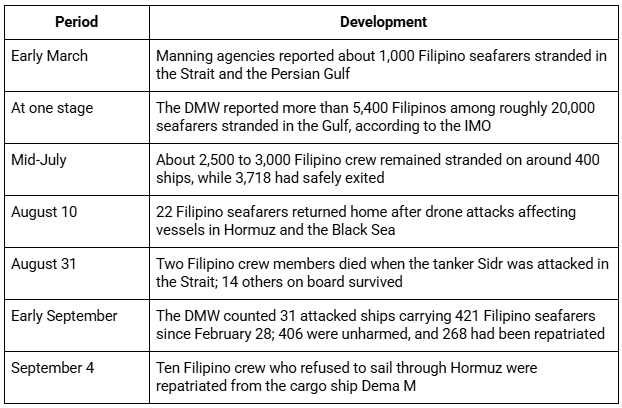
For context, here are the things that have happened in 2026 so far:
Rules that Manning Agencies and Seafarers Should Know
Department of Migrant Workers (DMW) Advisories in 2026
- Advisory No. 09: It is said that vessels carrying Filipino seafarers should avoid the Strait of Hormuz and other high-risk chokepoints, unless passage is absolutely required and backed up by a security risk assessment. Moreover, it is highlighted that stranded seafarers must receive meals, communication access, accommodation, and transportation. Agencies must also submit periodic status reports.
- Advisory No. 23: After a ceasefire happened, the DMW allowed a few temporary and conditional crew changes in risky zones. Also, they clarified that this was not a lifting of earlier suspensions. Nevertheless, hostilities later resumed, and Iran announced a renewed closure in July.
- Advisory No. 53: The DMW reminded shipowners and licensed manning agencies to improve their safety measures. Consequently, as the Sidr deaths occurred, the agency stressed that seafarers must receive enough information to reach informed decisions, and that seafarers’ refusals to sail must be acknowledged.
Additionally, reports in early September said the DMW was drafting a stricter advisory that would bar deployment on vessels transiting Hormuz. Around the same time, the DMW secretary had voiced reservations about a strict prohibition. Hence, it is necessary to stay updated with the DMW’s advisories to know their position on current issues.
Warlike Operations Area Protections
The International Transport Workers’ Federation (ITF) and the Joint Negotiating Group designated the Strait of Hormuz, the Persian Gulf, and the Gulf of Oman as a Warlike Operations Area on March 5, 2026. Thus, for covered seafarers, this means:
- A bonus equal to basic wage during the stay or transit
- Doubled compensation for death and disability
- The right to refuse to sail into the area, with repatriation at the company’s cost and compensation equal to two months’ basic wage
These terms apply only to ships whose companies are signatories to the International Bargaining Forum (IBF) agreements, comprising about 15,000 vessels worldwide. Likewise, the designation is reviewed regularly, so confirm its current status.
Philippine law and international standards
Republic Act No. 12021, or Magna Carta of Filipino Seafarers, outlines the rights and obligations of Filipino seafarers and implements the Maritime Labor Convention, 2006 (MLC), as amended, and the International Convention on Standards of Training, Certification and Watchkeeping for Seafarers (STCW) Convention.
Risks Considered for Manning Agencies
Here are several things that manning agencies should take note of as the Hormuz crisis is ongoing:
- Operational Disruption: Crew changes may call for rerouting, causing higher costs for airfare, accommodation, visas, and documentation. Additionally, Stranded crews must be supported, and the DMW is clear that seafarers should not carry the burden of those costs.
- Concentration risk: Agencies that depend heavily on Gulf trades or a single principal face the highest exposure when such a route closes.
- Compliance and liability: Non-compliance with DMW advisories can lead to exposure of principals and agencies to regulatory, contractual, and labor penalties. Also, the DMW has said that it is investigating shipowners and Philippine manning agencies linked to vessels attacked or endangered in Hormuz and the Black Sea.
- War-Bonus Trap: Some operators are offering very large payments to crews who are willing to transit the strait. As a result, in such instances, India’s shipping regulator has warned seafarers about unlicensed, short-lived operators dangling several times normal wages. The same goes for agencies: high pay never replaces informed consent, proper licensing, and a real safety assessment.
Planning by scenario
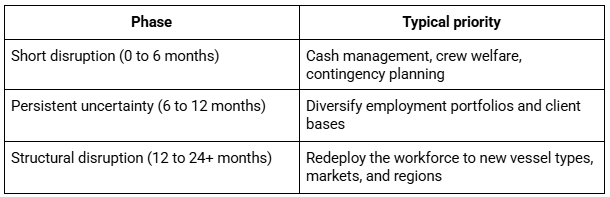
The crisis crossed the six-month mark in late August, which places us in the second phase below. Treat this as a planning framework, not a forecast.
Building Financial and Operational Durability
To address some remedies for the risks and other associated issues, here are a few steps worth taking:
1. Diversify Principals, routes, and vessel types
A key solution is to expand relationships beyond a single segment. According to the BIMCO/ICS data, general cargo ships (21.4%), bulk carriers (18.9%), and cruise ships (14.0%) make up the largest shares of officer demand. On the other hand, cruise ships (22.5%), bulk carriers (18.4%), and general cargo ships (18.0%) lead for ratings. Those segments offer deployment options beyond Gulf tanker trades.
2. Upskilling and Retraining
The global demand for certified seafarers has risen to 35% since 2021, and the baseline forecast tells that about 22,747 additional officers are joining the workforce each year through 2030. Due to the Philippines’ inclination to ratings workforce while officers are the scarce group, moving more ratings toward officer and specialist roles addresses the market gap and the income risk.
3. Develop Ancillary Services
It is worth considering other services that generate income that do not depend on each deployment. For instance, maritime training, wellness programs, crew logistics, payroll, compliance support, digital services, and family financial education. Simply put, the goal is to shift from deployment-based income toward long-term, value-added services across a seafarer’s career.
4. Improving Efficiency and Cost Control
- Using technology to automate documentation and optimize crew planning
- Track cost per deployment, lead time, retention, and profitability by principal
- Cutting some of the non-value-adding work
- Doing a stress test of cash flow
Conclusion
Overall, the issues on the Strait of Hormuz are a wake-up call for the Philippine maritime industry. Indeed, resilience will not come from waiting for normalcy, as it will come from building adaptable companies and careers, with Filipino seafarers employable in more markets and in higher-skilled roles, and manning agencies not dependent on any single shipping segment or region.
If you run a manning agency or another maritime-related business and want help with cash-flow planning, management accounting by principal, or audit-ready financial statements, get in touch with Babylon2k.
This article is for general information only and is not legal, tax, or financial advice.
References
- GMA News, “Strait of Hormuz listed as ‘high-risk area’ for Filipino seafarers — DMW.”
- BIMCO and International Chamber of Shipping, Seafarer Workforce Report 2026, Executive Summary (2026).
- GMA News, “Remittances hit seven-month high in July 2026” (BSP data).
- Manila Bulletin, “Remittances drop to 11-month low as global inflation pinches overseas Filipinos,” June 15, 2026.
- The Manila Times, “2,500 Filipino seafarers stranded in Persian Gulf,” July 12, 2026.
- SunStar, “Manning agencies told: Aid onboard, stranded seafarers” (DMW Advisory No. 09, Series of 2026).
- The Philippine Star, “2 Filipino sailors killed in Hormuz attack,” September 4, 2026.
- Seatrade Maritime News, “Philippines set to ban deployment of seafarers in Strait of Hormuz.”
- International Transport Workers’ Federation, “Joint ITF–JNG Statement: Warlike Operations Area in Strait of Hormuz continues under weekly review,” June 30, 2026.
- Republic Act No. 12021, An Act Providing for the Magna Carta of Filipino Seafarers (September 23, 2024).
- DMW Advisory No. 09-2026
- DMW Advisory No. 23-2026
- DMW Advisory No. 53-2026