A New Tool to Combat Rising Fuel Costs
As previously discussed in our article regarding the conflict between the US, Israel, and Iran, the global prices of fuel indeed continue to fluctuate. Several businesses and most of the consumers are carrying the weight of the burden because of its domino effect on transportation, logistics, and even commodities, creating pressure both on business operations and household budgets.
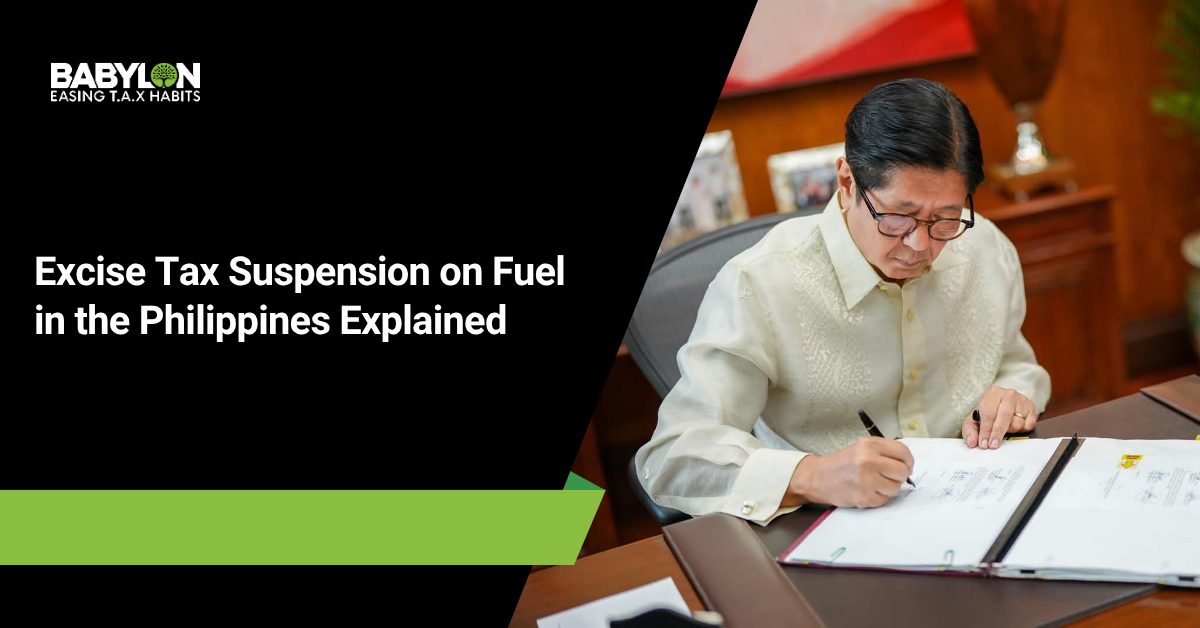
In response to the crisis, Republic Act No. 12316 has been recently signed into law by President Ferdinand Marcos Jr., which grants him the power to temporarily suspend or reduce excise taxes on petroleum products when certain periods of high global oil prices occur.
At first hand, it may seem to be a timely economic move, but is it truly enough?
What the Law Provides
R.A. 12316 amends Section 148 of the National Internal Revenue Code (NIRC), which introduces a data-triggered approach with regard to fuel tax relief.
The key provisions of the recently enacted law include:
- Activation of the Suspension: the President may suspend excise taxes when the Dubai Crude Oil prices, as per the Means of Platts Singapore (MOPS), reach or exceed $80 per barrel in one month
- Duration: The suspension may last for up to 3 months per instance, with a maximum period of 1 year in aggregate.
- Automatic Reversion: Excise taxes are automatically reverted, with no legislation required. As such, the triggering event for reversion is either of the two below, whichever comes first:
- One week after the oil price fell below $80 per barrel
- After the 3-month period lapses
- Validity of the Power to Suspend: The authority of the President to suspend is only until December 31, 2028.
In addition, there were also provisions pertinent to the required reports to be submitted by the President, through the Development Budget Coordination Committee (DBCC), in coordination with the Department of Energy (DOE), to Congress. Specifically, these are:
- Factual basis and policy goals regarding the suspension or reduction of excise taxes on petroleum products
- Estimated loss in anticipated revenues
- Expected economic impact of the said suspension, such as inflation consequences, fuel prices, cost-benefit analysis, possible market distortions, etc.
Furthermore, it was also mandated that oil companies must submit monthly pricing data to regulators in order to closely monitor the fuel prices and ultimately ensure that the goal of the law is attained.
Overall, it is impliedly emphasized that while flexibility is granted for the benefit of the general public, accountability shall be embedded.
The Business Impact of Fuel Tax Suspension
On the part of businesses, the provisions endorse both relief and opportunities:
Immediate Cost Relief
Since fuel is a major cost driver among industries, a reduction in excise tax can:
- Lower the expenses for logistics and transportation matters
- Improves operating margins, and
- Lessen the pressure on pricing strategies.
Moderation of Inflation
As fuel impacts most of the goods and services, with the reduction in fuel costs:
- Businesses may delay such an increase or actually reduce prices
- Consumers may experience a lesser impact of inflation
- Stabilizing demand can be attained
Better Forecasting
Because the suspension is data-triggered, businesses can:
- Expect potential tax adjustments
- Integrating scenarios in financial or budget forecasts
- Alignment of procurement and pricing decisions
Reality Check: Who Really Benefits?
Meanwhile, as R.A. 12316 is framed as a broad economic relief measure, specifically for the general public, its practical impact is more nuanced.
Advantage for the High-Consumption Sectors
For industries that require heavy fuel usage, such as logistics, manufacturing, and large-scale operators — they gain the upper hand. The reasons are:
- The higher the fuel consumption, the greater the savings attained
- Larger companies gain from scale-driven cost reductions
Moreover, for higher-income households, who typically consume more fuel, they may experience much more absolute savings.
Limited Direct Relief for the Public
On the other hand, for the general public, such benefits are often indirect and delayed.
- Lower fuel costs do not always equate to immediate lower transport fares or prices of goods
- Savings may be absorbed along the supply chain, but may not be delivered to the consumers themselves
Indeed, this raises a crucial consideration between the intention of the law and its actual impact. Furthermore, as the suspension of excise tax gives relief, it also comes with corresponding costs. Some of these are a reduction in government revenues and the potential after-effects on public expenditures, specifically for infrastructure and providing social services.
Hence, this raises a fundamental policy question: “Does the broad-based tax relief provide the most efficient way to support those who need it the most?”
What Should You Do Now?
Whether you are running a business or managing your budget and household expenses, the law presents both opportunities and considerations.
For Businesses:
- Assess your Exposure to Fuel Expense: Identifying where your business operations are most sensitive to fuel price changes can help you anticipate where you can attain your savings.
- Updating Financial Models: Integrating possible tax suspension scenarios into budgeting and forecasting helps to mitigate the risk of higher costs.
- Monitoring Policy Triggers: Being updated on announcements or news from economic experts or regulators is crucial.
- Seeking Professional Guidance: Alignment of tax, pricing, and compliance strategies will be of great importance and advantage.
For Consumers:
- Track Fuel Price Movements: Staying informed on oil price trends and global news that may have an impact on fluctuations.
- Planning Expenses Strategically: Use periods of lower fuel prices to optimize transportation, travel plans, or household budgeting.
- Advocate for Transparency: Support policies and businesses that fairly present their costs, and pass the savings to consumers.
A Strategic Tool, But Not a Complete Solution
In conclusion, RA 12316 represents a progressive and flexible policy response to the ongoing price volatility of oil. However, it’s important to note that such benefits are not evenly distributed to all. The effectiveness of the intent of the law will depend on the implementation and market behavior, and it will work best when it is complemented by specific economic measures, not as a standalone resolution.
For businesses and consumers, it reinforces the importance of remaining agile in financial planning and looking beyond the short-term cost relief. It is still best to understand the broader economic implications of the law and plan things ahead.
If you’d like to understand how R.A. 12316 affects your business, our team is ready to assist — because here at Babylon2k, we turn regulatory developments into clear, actionable strategies. Send us a message or schedule a consultation today.
References: