
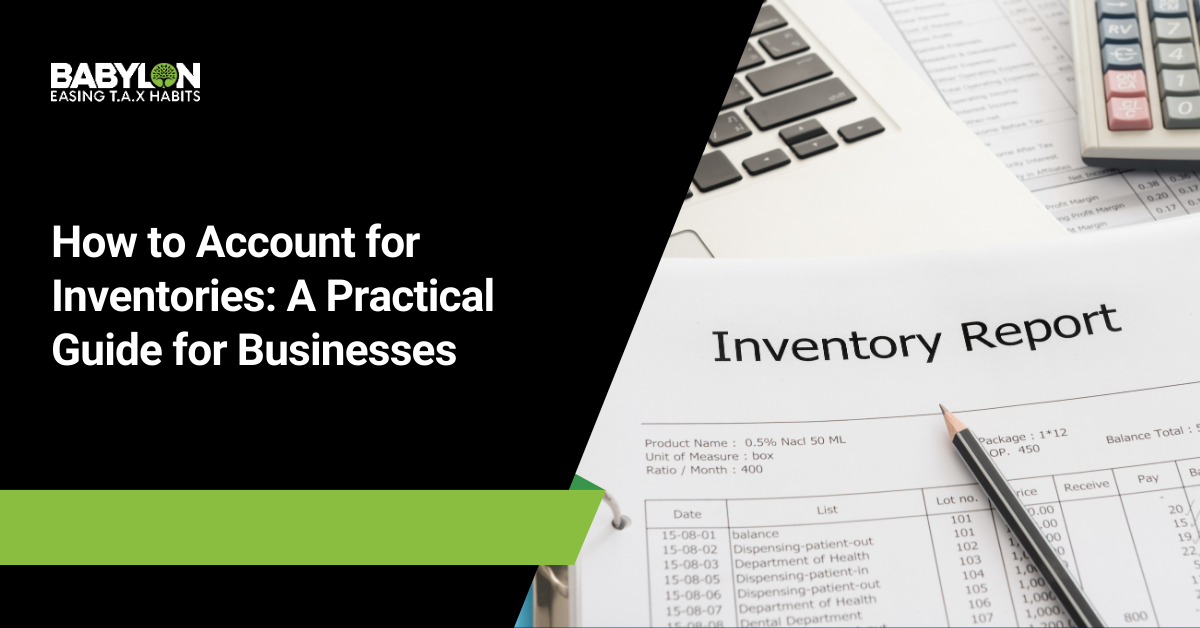
For many businesses and startups, Inventory is one of the crucial assets on the balance sheet — practically because it is the main derivation of sales. Yet, it is also one of the most misunderstood.
Inventory is not just about “stock”; it is cash sitting on your shelves or in your stockrooms.
If recorded inappropriately, it can overstate profits and understate expenses, leading to distorted financial reporting, distorted tax returns, and misleading managerial decisions.
In this article, we will break down how to properly account for inventories in general, including the technical topics:
- Perpetual vs. Periodic Inventory Systems
- Lower of Cost and Net Realizable Value (LCNRV)
- FIFO, LIFO, Weighted Average, Moving Average, and Specific Identification
Let’s simplify it and make it easier to understand.
What are Inventory Systems? - Perpetual vs. Periodic
As a business, you have a way of recording how you monitor your inventories and in accounting terms, these can be pertinent to two categories: The perpetual and periodic systems of inventory.
Before choosing a costing method, you must determine your inventory system in your business.
Perpetual Inventory System
Under this system, inventory records are updated in real time.
Every sale:
- Reduces inventory
- Recognizes Cost of Goods Sold (COGS)
This is commonly used by:
- Retailers with Point of Sale (POS) systems
- E-commerce businesses
- Companies using accounting software
Its advantage is that it is more accurate, has better internal control, and provides real-time stock monitoring.
Periodic Inventory System
Under this system, inventory is updated only at the end of the period. Thus, compared to a perpetual inventory system, it cannot reflect real-time records.
COGS is computed as:
Beginning Inventory + Purchases – Ending Inventory = Cost of Goods Sold
This is commonly used by:
- Startups
- Small Businesses; &
- Those without integrated systems
Given its simplicity and ease of implementation, it can increase the risk of shrinkage or inventory shortages and provide less internal control.
For growing businesses, shifting to a perpetual system can significantly improve decision-making and fraud prevention. However, due to impracticality and cost implications of implementing such system — it is definitely fine for a startup or small business to operate first under a periodic system
How to do Inventory Measurement: Lower of Cost and Net Realizable Value (LCNRV)
The applicable standard in the Philippines for Inventories is the Philippine Accounting Standards (PAS) 2. Inventories shall be measured on the lower of the Cost and the net realizable value
What is “Cost”?
But first, what is the Cost? Under the accounting parlance, cost of inventory includes:
- Purchase price
- Import duties and taxes that are non-refundable
- Freight-in
- For manufacturers: Direct Labor & Manufacturing Overhead
It is important to note these items when calculating inventory costs.
What is Net Realizable Value?
Net Realizable Value is the net amount a business expects to receive after deducting the costs of creating and selling inventory.
In order to compute the Net Realizable Value (NRV), it is:
Estimated selling price – Costs to Complete – Selling Expenses = Net Realizable Value
Why is there a need to apply the Lower of Cost or NRV?
The implication of the Lower of Cost or NRV is based on the accounting principle of Prudence, which means exercising due diligence to address uncertainties to prevent overstatement of assets or income and understatement of liabilities or expenses. Hence, this is aligning to the goal of reliability in financial reporting.
For illustrative purposes, let us say that the following circumstances are encountered in Inventory valuation:
- Cost of Inventory = ₱100
- Net Realizable Value of Inventory after deducting Completion Costs & Selling Expenses = ₱85
You must report inventory at ₱85, and recognize a loss of ₱15.
The Business Impact of failing to apply LCNRV properly can inflate income or overstate assets, which may lead to higher tax exposure and compliance risks.
Inventory Costing Methods Explained
After determining your inventory system and having a good understanding of Lower of Cost and Net Realizable Value, you may now choose your Cost flow assumption.
This affects the computation of:
- Cost of Goods Sold (COGS)
- Ending Inventory
- Net Income
- Taxable Income
First-In, First-Out (FIFO)
With this assumption, the oldest inventory is sold first.
This reflects the actual physical flow of inventories for many businesses, and inventory on books approximates current market costs.
This assumption is best for:
- Food businesses
- Pharmaceutical Establishments
- Businesses with expiration dates
Last-In, First-Out (LIFO)
Under this assumption, the newest inventory is sold first.
LIFO is not allowed under the Philippine accounting standards. Therefore, for educational purposes, this is only applicable in an academic context. The reason is that it unrealistically reflects the inventory flow.
However, under the United States’ Generally Accepted Accounting Principles (GAAP), LIFO may be used for cost flow in inventories.
Weighted Average Cost
In this costing method, all units are averaged to determine the cost per unit of inventory.
The formula for this is: Total Cost of Goods Available / Total Units Available
Some advantages of using the weighted average method include smoothing price changes and fluctuations, being easier to apply, and being less prone to manipulation risks.
This is common in:
- Commodity trading
- Hardware supplies
- Homogeneous goods
Moving Average Cost (Perpetual Average)
This is somewhat similar to weighted average costing; however, it uses the implications of the perpetual inventory system.
Regarding its formula: each time you purchase inventory, a new average cost is calculated. The newly computed average is to be used to calculate the Cost of Goods Sold.
Furthermore, it provides more accurate cost estimates in volatile markets and is especially useful for business owners who want real-time costing. However, this is practical only in automated systems and well-established businesses, since, as implied by the perpetual inventory system, it can be costly.
Best for:
- Retail chains
- E-commerce
- Distribution companies
Specific Identification
Given the method name, each unit is tracked individually. This is commonly used when:
- Items are unique
- High value per unit
This is the most precise method for costing. Yet, it is not practical for a large-volume business.
Some of the examples applicable to this method are:
- Cars
- Jewelry
- Real estate units
Why Your Inventory Method Matters
Having a good grasp of this can be about more than compliance — it can also be a strategy. It impacts your
- Profit presentation
- Tax Planning
- Cash Flow Management
- Managerial Concerns
Furthermore, choosing the wrong method can have disruptive effects, such as distortion of profit margins, triggering tax exposure, fostering auditing issues, and affecting the decisions of potential investors.
Inventory is Strategy
Accounting for inventories might be technical at first, but it is an investment skill that can scale a startup and further improve growing businesses. It is a factor for profitability, tax efficiency, and internal control.
Whether you’re running a retail store, manufacturing business, or distribution company — your inventory method must align with:
- Business model
- System capability
- Compliance standards
- Growth strategy
Here at Babylon2k, we help businesses build compliant, strategic, and scalable accounting systems, not just bookkeeping entries — because when inventory is accounted for properly, your numbers tell the truth, and your business grows with confidence.
Reach out to us whenever you need help with accounting, compliance, or strategy.





One Response
Thank you for all of your help. Your carrier became superb and really FAST. Many thank you for you type and green carrier. I even have already and could clearly hold to advise your offerings to others withinside the future.